
The Front Door Intranet: Turning the Intranet into a Platform Where Work Happens
This article explains how the front door intranet transforms traditional intranet solutions into platforms where work happens. It shows how employees can move from finding information to completing tasks and getting support in one unified experience—without switching between systems. By understanding this concept, organizations can design intranet solutions that reduce digital friction, simplify employee journeys, and improve productivity across the digital workplace.
The Front Door Intranet - Key Take-Aways
A front door intranet moves beyond information access to help employees complete work — guiding them through tasks, services, and processes in one unified experience.
In this article, you will learn:
 What a front door intranet is — and how it shifts the intranet's role from information portal to a platform where work actually happens.
- How AI moves from conversation to execution — enabling employees to go from asking a question to completing a task without switching systems.
- How the intranet acts as an experience layer — connecting Microsoft 365, HR systems, IT platforms, and other business applications behind the scenes.
- How guided employee journeys replace system navigation — so employees think in terms of tasks, not departments or platforms.
- Why simplicity is the front door intranet's greatest value — giving employees one trusted starting point for their daily work.

The role of the intranet is evolving. For years, the idea of a front door intranet has been discussed—a place where employees can find knowledge, access services, and use business tools. But in many organizations, this vision has been difficult to realize in practice.
This is now changing. With the rapid development of AI and greater integration across platforms, the front-door intranet is becoming a practical reality.
The principle is simple: employees should not need to navigate multiple systems or understand organizational structures just to complete a task. Instead, a front door intranet brings services, knowledge, and tools together in one unified experience—guiding employees and helping them complete everyday work more efficiently.
What Is a Front Door Intranet?
Traditionally, intranets have been designed as starting points where employees can find the information, tools, and services needed to do their work.
Using navigation, search, notifications, and content targeting, employees can locate the instructions required to complete a task—and then figure out which system they must use to get the work done.
While this approach provides access to information, it often leaves employees with a fragmented experience. They still need to know where processes live, which system to use, or which department owns a service.
A front door intranet is designed to go further. Instead of simply providing information and access to systems, it helps employees complete work.
If employees know what they want to accomplish, the front door intranet provides the relevant information and guides them step by step until the task is completed.
Using AI assistants, AI agents, workflows, and connectors to back-end systems, the intranet can provide guided journeys instead of simply presenting information.
→ Learn more: Industry research supports this shift. The Intranet & Employee Experience Platforms 2026 report highlights how modern intranets increasingly act as a central entry point for services, knowledge, and workplace tools. Download the report!
Example: How a Front Door Intranet Guides Employees Through Tasks
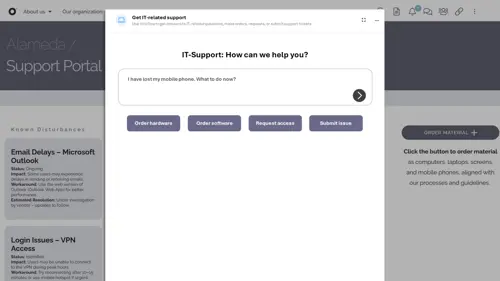
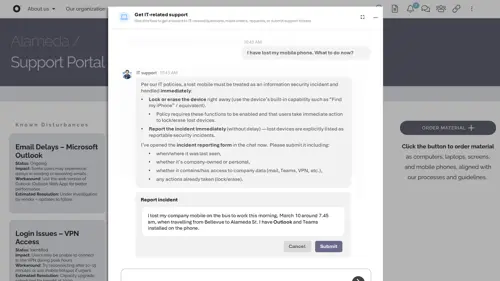
To understand how this works in practice, consider a common scenario: an employee loses their company mobile phone.
Instead of navigating several portals to figure out what to do, the employee starts on the intranet and asks for guidance. An AI assistant explains the process and helps the employee to report the lost device to IT.
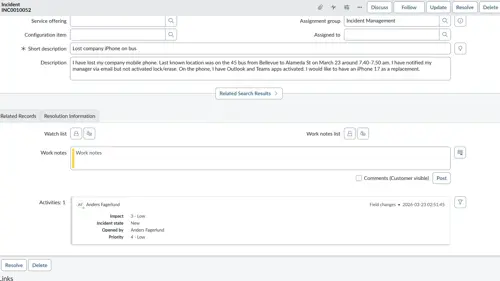
From the same interface, the employee can then request a replacement phone. The system checks available options, ensures the request follows company policies, and routes the order for manager approval. Once approved, the request is processed, and the phone is ordered.
For the employee, the entire journey—from understanding the process and reporting the issue to ordering a replacement device—occurs within a single guided experience, even though the knowledge, workflows, and transactions reside in different systems.
This shift—from navigating systems to completing tasks—is what defines the modern front door intranet.
→ Learn more: If you want to see how organizations design intranets that guide employees through tasks and services, we cover practical examples in our webinar “The Front Door Intranet: From Information Portal to Work Platform.” Register for the webinar here!
Moving AI From Conversation to Execution
Many organizations have experimented with AI assistants and chat-based tools that help employees find answers faster.
However, the actual work often still happens elsewhere. Requests, approvals, case handling, and task execution still take place across disconnected systems and manual processes.
Employees may receive guidance from AI, but still need to switch systems to complete the task.
Today, this gap can finally be closed. AI in the intranet can move from conversation to execution. Instead of only answering questions, AI can initiate workflows, trigger actions, coordinate processes, and guide employees through tasks step by step.
The result is a digital workplace where employees move directly from asking a question to completing work. This shift turns the front door intranet from a place to read information into a platform where work actually happens.
→ Learn more: This shift is also reflected in analyst research. The 2025 Gartner Magic Quadrant for Intranet Packaged Solutions also highlights how modern intranet platforms increasingly support integrations, workflows, and AI-driven employee experiences. Download the Magic Quadrant for IPS!
How the Front Door Intranet Connects Systems
To support this model, the intranet must connect the platforms employees rely on every day.
In practice, this means the intranet becomes the experience layer of the digital workplace—connecting systems, knowledge, and workflows in one unified interface.
Modern intranets increasingly act as an orchestration layer across the digital workplace, integrating services and information from platforms such as Microsoft 365, HR systems, IT service management platforms, and other business applications.
Through integrations and connectors, the intranet can retrieve information, initiate workflows, and coordinate tasks across these systems.
Employees do not need to understand where processes run or which system owns the data. Instead, they interact with a unified experience while the intranet coordinates knowledge, services, and workflows behind the scenes.
This orchestration capability is what makes the front door intranet practical in complex enterprise environments.
Designing the Front Door Intranet Around Employee Journeys
Another important shift is how intranets are designed.
Traditional portals often mirror organizational structures—departments, systems, or internal ownership.
But employees rarely think in terms of departments. They think in terms of tasks.
A front door intranet is therefore structured around common employee journeys, such as onboarding, requesting services, solving workplace issues, accessing knowledge, or completing everyday tasks.
By organizing the intranet around these journeys, organizations create experiences that are easier to navigate and more useful in daily work.
Instead of asking employees to understand how the organization is structured, the intranet guides them through the steps needed to complete their tasks.
The Front Door Intranet: A Simpler and More Intelligent Digital Workplace
Ultimately, the value of the front door intranet lies in simplicity.
Employees should not need to remember which platform contains a document, where a service request should be submitted, or which team owns a process. They should simply start in one place—the front door intranet—and be guided to what they need.
For years, the idea of the intranet as the front door to the digital workplace was largely a vision. Today, with AI assistants, workflows, and integrations connecting enterprise systems, it is rapidly becoming a practical reality.
Organizations that embrace this approach transform the intranet from a passive information site into a platform that actively supports employees in solving problems, completing tasks, and moving work forward.
In a digital workplace that continues to grow in complexity, the intranet’s most important role may be its simplest one: providing a clear and trusted front door intranet that helps employees complete their daily work.
→ Learn more: If you would like to see how a front door intranet works in practice, you can also book a 30-minute demo of Omnia, where we walk through real examples of guided journeys, integrations, and AI-supported workflows. Book a demo to learn more about the front door intranet!
Article date
2026-04-13 10:26