
AI in Intranet Platforms: What Are Major Shifts in 2026—and What’s Coming Next

AI is now embedded across most intranet and employee experience platforms—but maturity, value, and governance still vary widely. This article explores how AI is being used in intranets today, where capabilities such as search, communications, and agents are delivering real value, and how organizations should evaluate AI realistically when planning a new or improved intranet.

Who this article is for: This article is for intranet owners, digital workplace leaders, and IT or communications professionals who want to understand where AI delivers real value in intranet platforms—and where expectations should remain realistic.
What this article helps with: The texthelps clarify which AI capabilities are mature enough to use today, which are still emerging, and how to assess AI features without adding unnecessary complexity, cost, or risk.
Artificial intelligence is no longer an emerging capability in intranet platforms—instead, it is a common part of the conversation. Over the past few years, AI has evolved from basic generative tools for drafting content into more advanced capabilities that support intranet search, analytics, and early forms of digital workplace automation. As a result, many organizations now expect AI to improve findability, reduce friction, and help employees work become more productive.
At the same time, uncertainty remains around which AI capabilities are genuinely ready for use at scale. For practitioners, the key question has shifted from “Does this intranet platform include AI?” to “Where does AI measurably improve outcomes—and where does it introduce new complexity, governance challenges, or cost?”
In many cases, the most impactful AI capabilities are not the most visible ones, but those that quietly improve relevance, quality, and decision-making behind the scenes.
This article examines how AI is being used in intranet platforms in 2026, based on independent product evaluations and market analysis from ClearBox Consulting’s Intranet & Employee Experience Platforms 2026 report. The below analysis is also informed by over 20 years of hands-on experience designing and managing enterprise intranet solutions.
Main Findings – How AI is Showing Up in Intranet Platforms
Across the intranet and employee experience platforms reviewed for the 2026 report, AI is widely present but still far from mature. Rather than appearing as a single, clearly defined capability, AI shows up in different ways across platforms, embedded into existing features such as content creation, intranet search, analytics, and integrations.
This also reflects a broader market shift: AI is no longer positioned as a headline feature in its own right, but as a way to enhance how intranets support everyday work.
AI capabilities are largely additive in intranets
One of the most important findings in the report is that AI capabilities in intranet platforms are largely additive rather than transformational. In most products, AI improves speed, convenience, and relevance, but it does not fundamentally change how intranets operate. Generative AI helps communicators work more efficiently, AI-enhanced search reduces the effort required to find information, and early agent-based features simplify specific tasks.
However, few platforms currently demonstrate AI-driven experiences that replace existing workflows end-to-end. For practitioners, this means AI should be evaluated as a way to strengthen core intranet scenarios—not as a shortcut to solving more complex content, workflow, or governance challenges.
AI maturity varies significantly across use cases
Another clear pattern is that AI maturity varies considerably depending on the use case. Generative AI for content creation has become a standard feature and is generally reliable. AI-enhanced search has advanced rapidly, but remains highly dependent on content quality and permission structures to deliver trustworthy results.
More ambitious capabilities—such as digital workplace agents that complete tasks across multiple systems—are available in some platforms, but remain limited in scope and heavily reliant on existing integrations and processes. Organizations should therefore expect a mixed landscape, where only some AI capabilities are ready for broad adoption, while others require careful evaluation and piloting before being rolled out at scale.
Content governance is essential for sustainable AI adoption
Governance has emerged as a defining factor for successful AI adoption in intranet platforms. While many vendors now offer AI-powered features, fewer provide robust controls for scoping data sources, managing permissions, tuning AI behaviour, or understanding how AI-generated results are produced.
The 2026 report points to that platforms that treat AI as a governed capability—rather than a generic layer applied across all content—are better positioned to support sustainable use at scale.
For organizations, this reinforces the importance of strong content governance, clear ownership, and transparent administration when introducing AI into the intranet.
Four AI Capability Themes Shaping Intranet Platforms in 2026
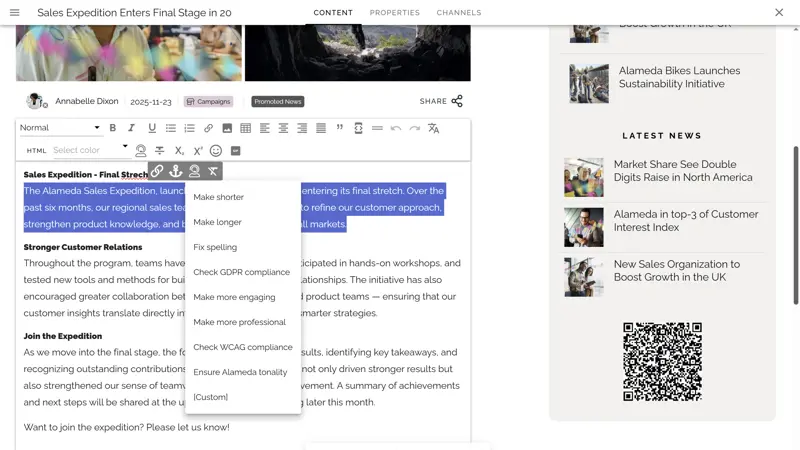
AI in intranet platforms #1: AI-powered communication enhancements
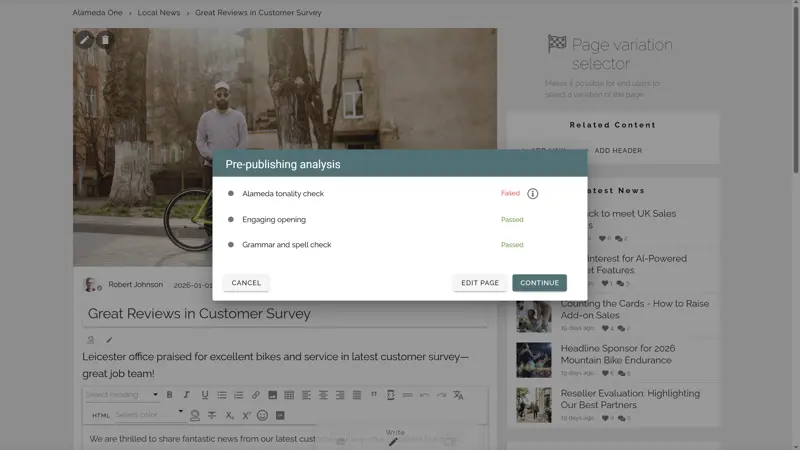
Generative AI was the first AI capability to appear on intranet platforms and is now nearly ubiquitous. Most platforms support AI-assisted text and image creation for news, pages, and updates. Increasingly, these tools go beyond basic generation to include tone-of-voice guidance, company context, and recommendations for improving clarity or engagement.
For internal communicators, this shifts AI from a simple writing aid to a quality- and consistency-enabler. More advanced platforms also use AI to optimise how content is delivered and consumed. AI-generated summaries, audio versions of articles, and automated digests provide alternative ways for employees—particularly frontline workers—to engage with information.
Some platforms apply behavioural data and content metadata to support smarter content delivery based on urgency, role, or working patterns. Used well, these capabilities help communicators focus less on producing content and more on improving its effectiveness.
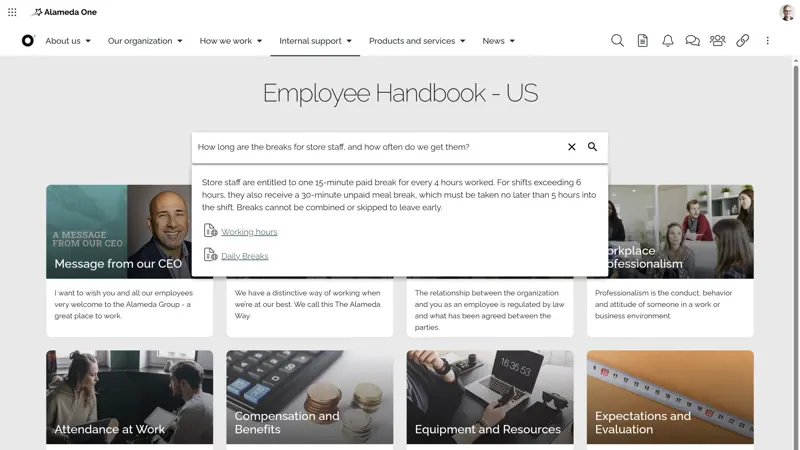
AI in intranet platforms #2: AI-enhanced search and findability
Search is one of the areas where AI has advanced most rapidly—and where expectations have risen sharply. Many intranet platforms now support natural language queries through chat-style interfaces or AI-enhanced search bars. In the strongest implementations, employees can ask questions in plain language, receive summarised answers, view source content, and refine results through follow-up queries.
However, AI search does not replace the fundamentals of good findability. Platforms with weak metadata, poor content governance, or limited search tuning tools often struggle to deliver reliable AI-driven results. Permission handling, transparency around sources, and hybrid experiences that combine AI-generated answers with traditional search results are critical for building trust.
For intranet owners, AI search should be evaluated as part of a broader findability strategy—not as a standalone feature.
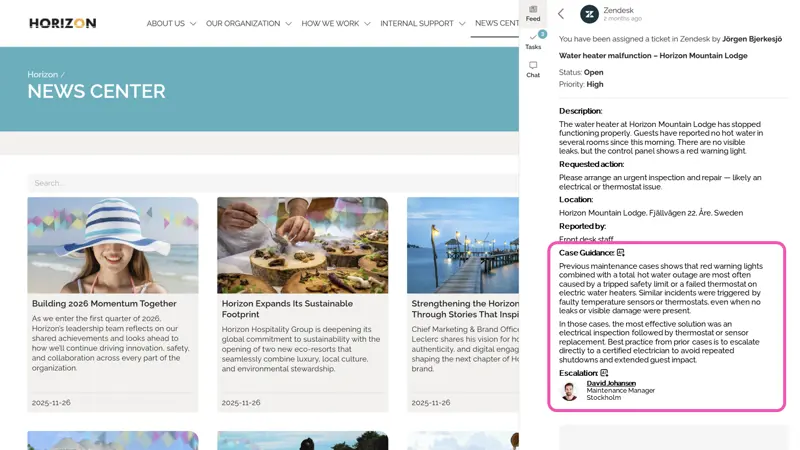
AI in intranet platforms #3: AI agents and task automation
Digital workplace agents are one of the most visible AI developments in intranet platforms. In simple terms, these agents allow employees to complete tasks through a conversational interface without navigating multiple systems. Typical examples include HR or IT self-service tasks such as requesting leave or accessing policies.
In practice, current agent capabilities are limited in scope and heavily dependent on existing integrations and workflows. Agents do not create new processes; they automate what already exists. Most platforms focus on specific domains rather than delivering fully autonomous, cross-system agents. For organisations, this means agents should be approached with realistic expectations and used to enhance well-defined services rather than replace process design.
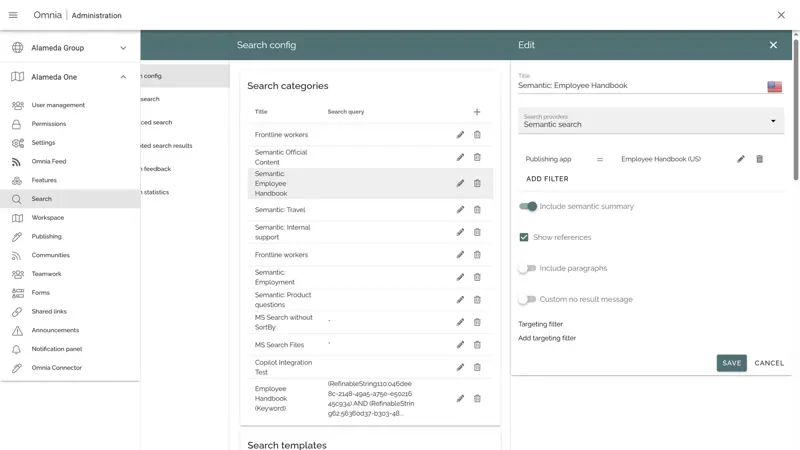
AI in intranet platforms #4: AI support for administrators and owners
Some of the most valuable AI capabilities in intranet platforms are aimed at administrators and content owners rather than end users. These include AI-driven analytics, automatic metadata tagging, lifecycle management support, and recommendations that highlight underperforming or outdated content. Several platforms also use AI to identify content gaps based on search behaviour or detect duplication.
Admin-focused AI often delivers faster and more sustainable value than highly visible AI features. By reducing manual effort and supporting decisions, these capabilities help organizations manage intranets at scale—particularly in decentralised publishing models. As these tools mature, AI is likely to become a core part of maintaining intranet quality over time.
Where is intranet AI heading next?
AI is reshaping intranet platforms not by replacing them, but by making them more adaptive and actionable. One clear direction is the renewed role of the intranet as an intelligent front door to the digital workplace—where employees can find information, complete tasks, and access services across systems. AI supports this shift by surfacing relevant content, guiding users to services, and reducing navigation complexity.
Search experiences are also evolving toward hybrid models that combine AI-generated answers with traditional result lists, refiners, and promoted content. This balance helps maintain trust and governance while improving speed and relevance. At the same time, digital workplace agents are expected to expand gradually, focusing first on well-defined service areas rather than broad automation.
Perhaps the most promising direction lies in governance and administration. AI is increasingly used to support content lifecycle management, quality control, and optimisation—helping intranet teams identify risks, gaps, and opportunities before they impact users. Over time, AI is likely to become a standard part of intranet administration, reducing manual effort and enabling more proactive management.
How organisations should use this information when planning an AI-enabled intranet
AI can deliver real value in an intranet—but only when applied deliberately and aligned with clear use cases. When planning a new intranet or evolving an existing one, organizations should:
✔ Start with intranet scenarios, not AI features. Define the outcomes you want to improve—such as findability, communication effectiveness, or service access—before assessing AI capabilities.
✔ Prioritise mature use cases. AI-enhanced search, communications optimisation, and admin support typically deliver value faster than advanced agent-based automation.
✔ Assess governance early. Ensure AI features respect permissions, provide transparency, and give administrators control over behaviour and data sources.
✔ Be realistic about agents. Focus on well-integrated, repeatable services rather than complex workflows.
✔ Plan phased adoption. Introduce AI incrementally, monitor performance, and adapt governance as capabilities mature.
✔ Consider long-term sustainability. Understand cost models, admin effort, and how AI supports ongoing intranet quality—not just innovation.
Conclusion: AI is an enabler—not the destination
AI is clearly reshaping intranet and employee experience platforms, but it does not change the fundamental purpose of the intranet. The most successful platforms use AI to strengthen core scenarios such as communications management, information finding and search, service delivery, and platform management and governance—rather than treating AI as a goal in itself.
For practitioners, the key takeaway from the 2026 market findings is that AI must be evaluated in context. Strong intranet outcomes still depend on clear strategy, effective content governance, thoughtful integration, and disciplined platform management and governance. AI can accelerate progress in these areas, but it does not replace them.
To understand how AI connects to other scenarios within the intranet context, check out our blog posts on information finding and search, communications management, knowledge and content management, and employee experience - or take part in the broader article summarising how the intranet use cases and capabilities fit together.
Explore the full 2026 intranet landscape
This article is part of a series analysing the key scenarios from the independent Intranet & Employee Experience Platforms 2026 report by ClearBox Consulting.
👉 Read this blog providing an overview of intranet and employee experience capabilities—or download the full Intranet & Employee Experience Platforms 2026 report to benchmark intranet platforms across all scenarios.