
Information Finding and Search in Intranet Platforms: What Works in 2026—and What Still Breaks

Information finding and intranet search remain among the most critical—and most challenging—capabilities in modern intranet platforms. While AI-enhanced search has improved how employees interact with information, maturity and reliability still vary widely. This article explores how information finding and intranet search are evolving in 2026 and how organizations should evaluate search capabilities realistically when planning a new intranet.

Who this article is for: This article is for intranet owners, knowledge managers, and digital workplace teams focused on improving findability, intranet search, and employee access to information.
What this article helps with: It helps clarify what actually drives effective intranet search and findability in practice—including the role of AI, governance, content quality, metadata, and administrative control—so teams can focus on sustainable improvements rather than surface-level fixes.
Finding information remains one of the most persistent pain points in enterprise intranets. When employees cannot quickly locate policies, documents, expertise, or updates, productivity suffers and trust in the intranet declines. Despite ongoing investment in search technology, many organizations still hear the same frustration: “I know the information exists—I just can’t find it.” In hybrid and distributed digital workplaces, effective information finding is a core requirement for intranet success—not a nice-to-have feature.
Over the past few years, intranet search capabilities have evolved significantly. AI-enhanced search, natural language queries, and chat-based interfaces are now common across many platforms, raising expectations among employees. However, these advances have also exposed long-standing challenges. AI can improve retrieval and presentation, but it cannot compensate for weak content governance, inconsistent metadata, or unclear ownership. As a result, many organizations find that search appears more advanced on the surface, while underlying findability issues remain unresolved.
This article examines how information finding and intranet search capabilities are being delivered in intranet platforms in 2026, based on independent product evaluations and market analysis from ClearBox Consulting’s Intranet & Employee Experience Platforms 2026 report. Conclusions are also based on 20+ years of hands-on experience designing, implementing, and sustaining enterprise intranet solutions.
Main findings – how information finding and search are evolving in intranet platforms
Information finding and intranet search continue to be among the most critical—and most challenging—capabilities in modern intranet platforms. While almost every product now claims to offer powerful search, the 2026 market findings reveal a gap between availability and effectiveness. Many platforms have improved their search experiences, particularly through AI, but success still depends heavily on governance and content quality.
AI-enhanced search is becoming common—but quality varies widely
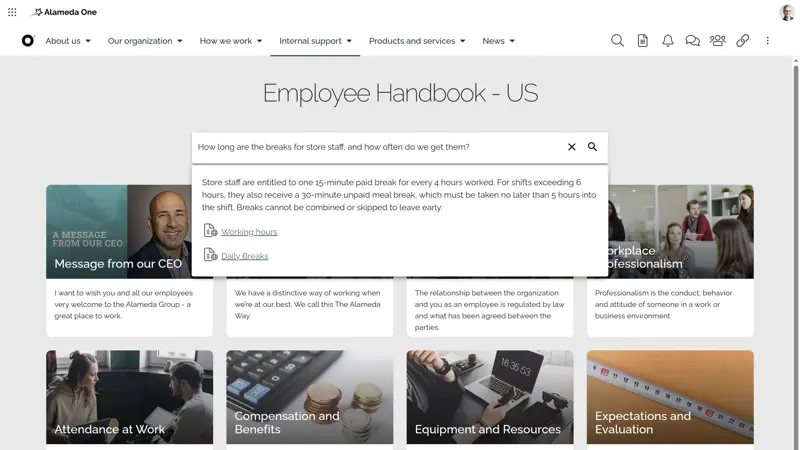
A majority of intranet platforms now include AI-enhanced search features such as natural language queries, chat-style interfaces, or AI-generated summaries. In the strongest implementations, employees can ask questions in plain language, receive clear answers with cited sources, and refine results through follow-up queries.
However, reliability and transparency vary significantly. Some platforms provide permission-aware answers with clear source references, while others surface AI-generated responses with limited context or control. When employees cannot understand where results come from—or why content is missing—trust in intranet search quickly erodes. AI-enhanced search should therefore be seen as an enhancement, not a guarantee of better findability.
Traditional search fundamentals still matter
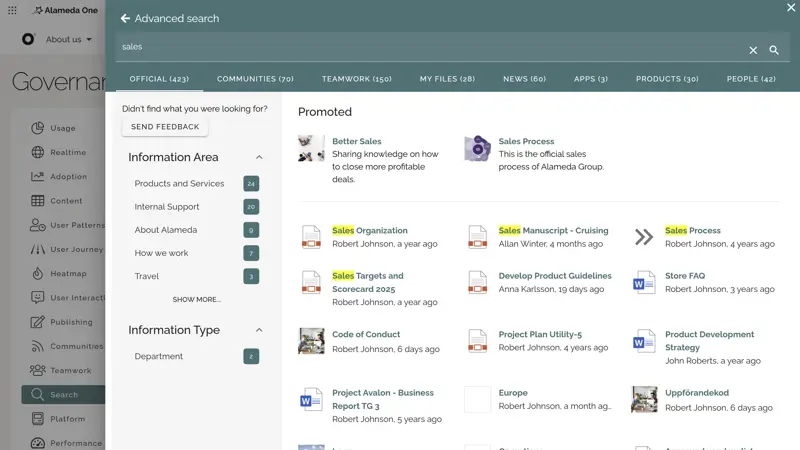
Despite advances in AI, traditional search capabilities remain essential. Features such as relevance tuning, refiners, promoted results, and reliable document indexing continue to make or break the search experience. Platforms that lack these fundamentals often struggle, even when AI layers are added on top.
The findings reinforce a consistent pattern: AI cannot compensate for weak search foundations. When employees are unable to filter results, understand relevance, or quickly access key content, confidence in intranet search declines—regardless of how advanced the interface appears.
Governance and content quality directly impact search success
Search performance is closely tied to governance. In many cases, search “failures” are not caused by technology limitations, but by inconsistent metadata, outdated content, or unclear ownership. Platforms that provide tools for metadata management, lifecycle controls, and content quality reporting tend to deliver more reliable search experiences.
AI-driven tagging and metadata suggestions are beginning to help address these challenges, but they are not yet consistent across the market. Organizations with strong content governance models are far more likely to benefit from AI-enhanced search than those relying on automation alone.
Federated search is improving—but remains complex
Employees increasingly expect intranet search to surface information from across the digital workplace, including Microsoft 365 and other third-party systems. Federated search capabilities have improved but remain complex to implement and manage.
Key challenges include permission handling, result relevance, and clarity around what is being searched. Platforms differ widely in how well they integrate external systems and present combined results in a way that employees can trust. Poorly implemented federated search can create confusion rather than clarity.
People search is generally strong—but underused
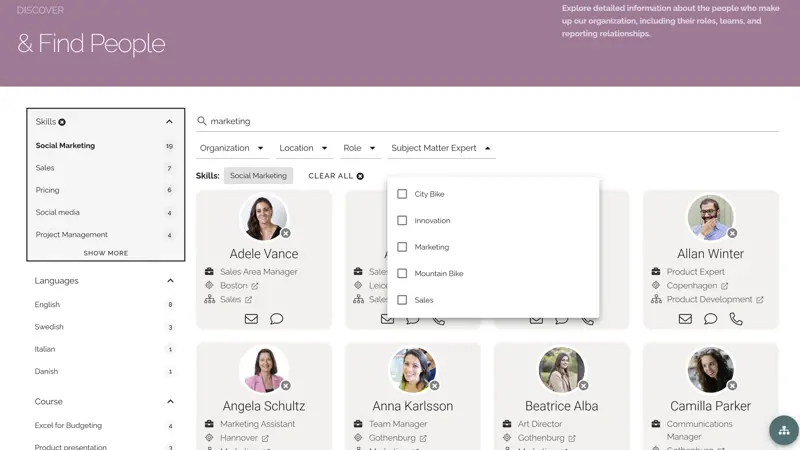
Most intranet platforms offer solid people search capabilities, allowing employees to search across profile attributes such as role, location, skills, or expertise. In some platforms, AI-enhanced people search supports natural language queries for finding subject-matter experts or relevant colleagues.
Despite this, people search is often underutilised due to incomplete profiles, limited incentives to maintain information, or weak integration with broader search experiences. This represents a missed opportunity, particularly for knowledge sharing and collaboration.
Search analytics remains inconsistent and underdeveloped
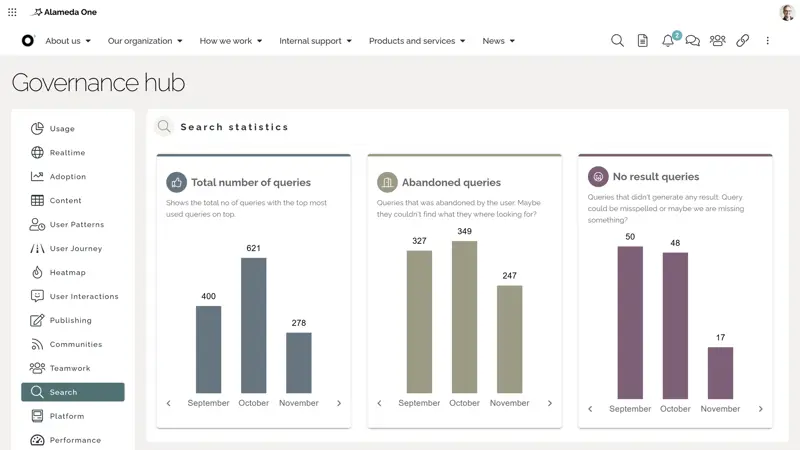
Search analytics is one of the weakest areas across intranet platforms. While some products provide basic insights into popular queries or failed searches, many offer little actionable data to support continuous improvement.
More advanced platforms are beginning to introduce AI-supported analytics that highlight trends, identify gaps, or suggest improvements. However, these capabilities are uneven and not yet standard. Without meaningful search analytics, organizations struggle to move from reactive fixes to proactive optimisation.
Where intranet search and findability are heading
Intranet search and findability are entering a period of refinement rather than radical reinvention. While AI has accelerated innovation, the most meaningful progress is coming from better integration of search into everyday work, stronger governance controls, and clearer accountability for findability outcomes.
From standalone search to guided information discovery
Search is becoming less of a single destination and more of an embedded capability. Instead of relying solely on a global search box, intranet platforms are beginning to surface information contextually—within pages, hubs, and task flows.
This supports guided information discovery, where employees are directed to relevant content based on context, role, or activity. Over time, this reduces reliance on navigation and manual searching while improving confidence in the intranet.
AI as an assistant—not a replacement—for search
The most effective future-ready platforms treat AI as a retrieval and summarisation assistant rather than a replacement for traditional search. AI-generated answers are combined with source visibility, follow-up questions, and the ability to fall back to traditional result lists.
This hybrid approach balances speed with trust, helping employees understand not just what the answer is, but where it comes from and why it is relevant.
Greater emphasis on admin control and governance
As AI becomes more embedded in search, governance is becoming a key differentiator. Intranet platforms are increasingly expected to provide administrators with tools to tune relevance, scope AI behaviour, manage promoted results, and collect feedback on search quality.
Search success is shifting from a one-time configuration task to an ongoing management discipline supported by data and governance.
Federated search is becoming more intentional and focused
Rather than attempting to search everything by default, future intranet platforms are moving toward more intentional federated search experiences. This includes scoped searches for specific domains—such as HR, IT, or knowledge bases—alongside broader enterprise search.
Clear communication about what is being searched, combined with permission-aware results, will be essential for maintaining trust and relevance.
Search analytics evolving into a driver for improvement
Search analytics is expected to play a larger role in improving intranet findability. Instead of simply reporting activity, analytics will increasingly identify unmet information needs, content gaps, and optimisation opportunities.
AI has the potential to accelerate this shift by translating raw data into actionable insights, supporting a move from reactive fixes to proactive, continuous improvement.
How organizations should use this information when planning for intranet search
Effective intranet search is not achieved by technology alone. It requires clear goals, strong governance, and ongoing optimisation. When planning a new intranet or improving search and findability in an existing one, organizations should:
✔ Define what “good findability” means based on critical content, tasks, and employee needs.
✔ Audit content quality and governance before investing in new search technology.
✔ Evaluate search experiences using real employee queries, not idealised demos.
✔ Assess AI-enhanced search alongside governance controls, transparency, and permissions.
✔ Plan federated search intentionally, with clear scoping and communication.
✔ Treat search optimisation as an ongoing discipline, supported by analytics and feedback.
Conclusion: Intranet search succeeds when foundations are strong
Intranet search and findability remain strategic capabilities that directly influence productivity, trust, and intranet adoption. While AI-enhanced search has improved how employees interact with information, it does not replace the fundamentals of effective findability. Strong governance, high-quality content, and continuous optimisation remain essential.
For practitioners, the key takeaway is clear: successful intranet search is built on solid foundations and sustained over time. AI can enhance discovery and relevance, but long-term success depends on clear ownership, consistent metadata, and the ability to learn from real user behaviour through analytics and feedback.
Strong intranet search does not exist in isolation. It relies on content quality, governance, and integration across the wider platform—including communications management, knowledge and content management, and service delivery.
To understand how search and findability connect with broader intranet and employee experience trends, explore the blog posts about AI in intranet platforms, communications management, and knowledge management and governance.
Explore the full 2026 intranet landscape
This article is part of a series analysing the key scenarios from the independent Intranet & Employee Experience Platforms 2026 report by ClearBox Consulting.
👉 Read this blog for an overview of scenarios and shifts in the intranet landscape—or download the full Intranet & Employee Experience Platforms 2026 report to benchmark intranet platforms across all scenarios.