
Intranet Transformation: Five Key Shifts You Need to Know
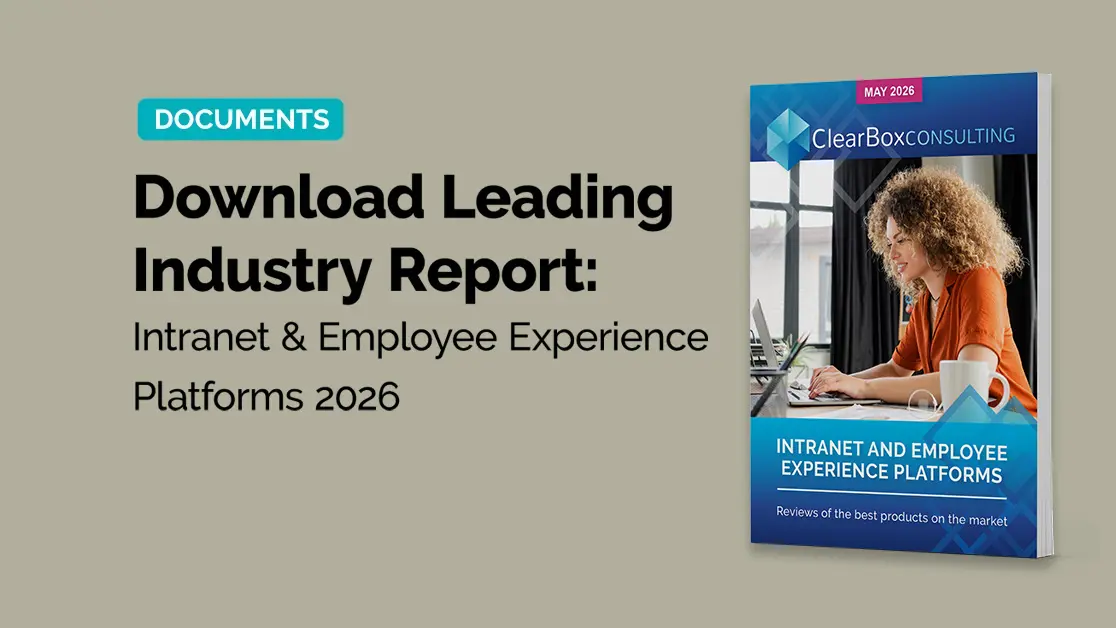
Employee and organizational expectations are rising fast, pushing intranets to evolve. As AI accelerates, hybrid work matures, and frontline needs grow, many organizations are rethinking what a modern intranet must deliver in 2026 and beyond. If you’re planning improvements or exploring new intranet platforms, this blog breaks down intranet transformation and the shifts you need to understand.

Intranet transformation is constantly ongoing, and right now we see a pivotal new phase gaining momentum. Shaped by hybrid work, the rise of AI, increasing employee expectations, and the need to unify a fragmented user experience, intranets are moving beyond communication to better support daily workflows and the overall employee experience for both office and frontline teams.
Since the intranet has the power to define how employees access information, collaborate, and engage with the organization, it is important to understand present intranet transformation when designing a new solution or improving an existing one.
In this blog, we highlight five major shifts in the intranet market and share advice on what capabilities to look out for in 2026. If you want to explore intranet transformation in depth – including 25+ screenshots and modern intranet examples – download the free guide: Top Intranet Trends for 2026 and Beyond.
Intranet Transformation #1: Communication Must Be Targeted, Multi-Channel, and Measurable
Even as intranets evolve to better support daily productivity, improving internal communication will remain a top priority for organizations in 2026. So let’s start with one of the most visible shifts in this space?– the rising expectation for communication effectiveness.
Editors want AI-powered tools that help them create, refine, and manage content. Employees want to cut through the noise and receive timely, relevant updates in the channels they prefer. And organizations want clear evidence that communication is reaching the right people and improving over time.
In 2026, modern intranets will act less like news portals and more like communication engines?–?coordinating reach, personalizing messages, and enabling decisions.
Intranet Feature Examples: Effective Communication
These communication capabilities will gain importance in the year ahead:
✔ AI-enhanced publishing tools for generating, refining, summarizing, translating, and reviewing content — complete with optimal publish-time suggestions.
✔ Precision targeting models that deliver content to the right audiences based on role, department, location, or any user property — and personalize messages automatically.
✔ Multi-channel orchestration that publishes once and distributes across web, mobile, Teams, email, and digital signage from one unified flow.
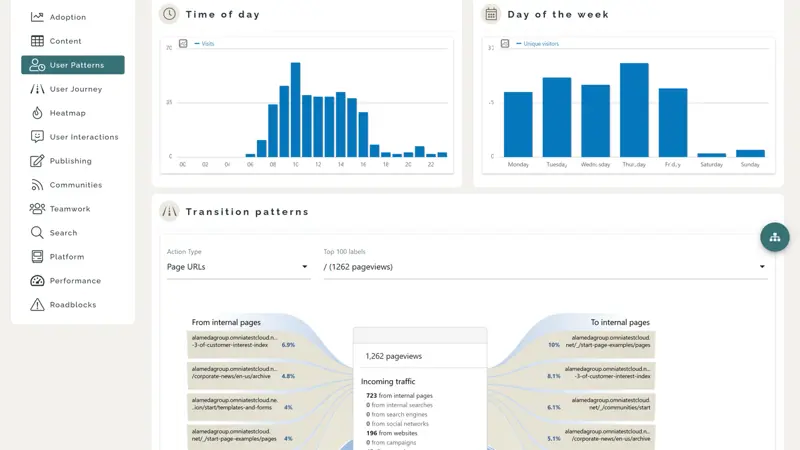
✔ Advanced communication analytics that track reach, read depth, interactions, device usage, and channel performance to support continuous improvement.
Intranet Transformation #2: From Communication Portal to Integrated Work Platform
As stated earlier, modern intranets are evolving into true work platforms that bring tasks, services, and daily workflows into one connected experience. Employees want a single place to start their day — seeing what needs attention, completing requests, finding accurate information, and accessing tools without jumping between systems.
Organizations, in turn, benefit from reduced friction, clearer processes, and improved productivity across the digital workplace. To deliver this, intranets must integrate smoothly with Microsoft 365 and key business systems, provide governed and reliable information, and present personalized tasks and services across devices. We believe that this shift increasingly applies to frontline and mobile workers, who need fast access to updates, tasks, and actions from any device.
In 2026, more intranets will connect deeply with enterprise systems and provide personalized work interfaces that help every employee stay focused on what matters.
Intranet Feature Examples: Work Platform
These are work platform capabilities that will grow rapidly in importance:
✔ Two-way integrations with business systems that surface tasks, send notifications, and allow employees to complete actions directly from the intranet.
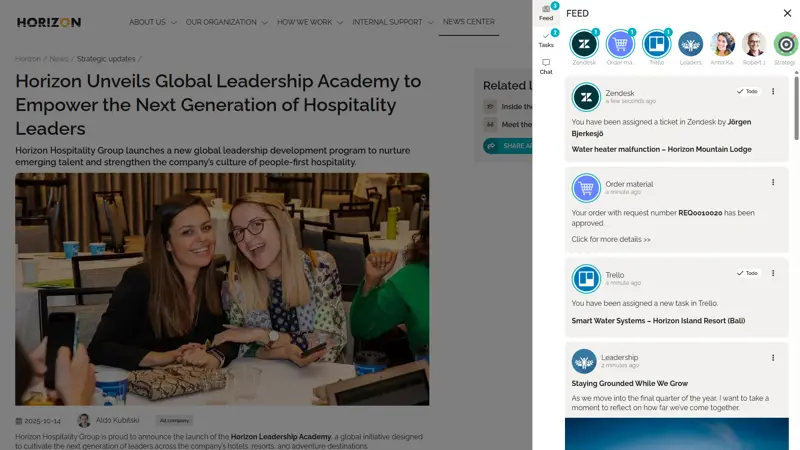
✔ Unified task views that consolidate assignments from Microsoft 365 and third-party systems into one clear, personalized overview.
✔ Unified service hubs for HR, IT, and workplace processes — centralizing forms, workflows, approvals, and self-service in one intuitive location.
✔ Governed knowledge bases that ensure employees always access accurate, compliant, and versioned information to support daily work.?
Intranet Transformation #3: Employee Experience –Supporting the Full Employee Journey
As intranets take on a larger role in the digital workplace, expectations around employee experience are rising quickly. Employees want structured, personal, and easy-to-navigate experiences that support them throughout their journey — from onboarding and learning to recognition, community, and career mobility.
Organizations, in turn, want tools that strengthen culture, promote participation, and help people grow in a consistent, meaningful way. And again, this doesn’t apply only to office-based teams — modern intranets must support distributed teams to ensure every employee feels informed and connected.
In 2026, the intranet will become an increasingly essential touchpoint for how employees – both office and fromline teams – stay engaged, feel supported, and build long-term connection with their organization.
Intranet Feature Examples: Employee Experience
These capabilities will be increasingly important:
✔ Guided onboarding and learning journeys that help new hires ramp up quickly and provide clear pathways for ongoing development.
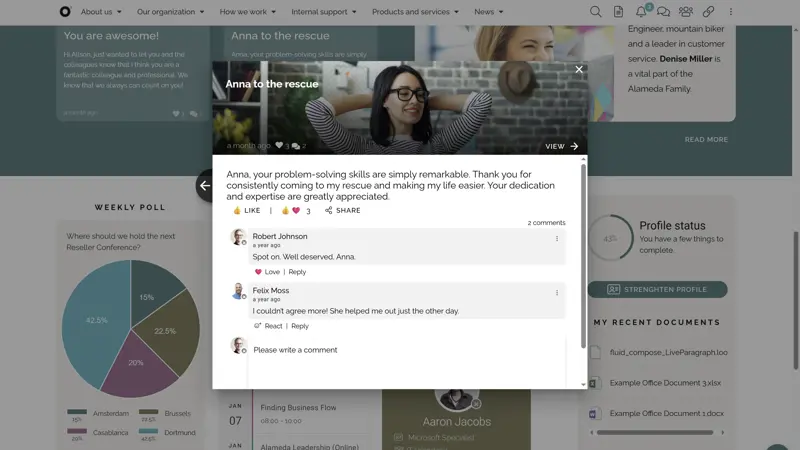
✔ Recognition and career-growth tools that celebrate contributions, highlight cultural moments, and showcase open positions or development opportunities.
✔ Community spaces where employees can share knowledge, collaborate, celebrate wins, and learn from peers across the organization.
✔ Employee voice and ideation features that gather feedback through polls, surveys, and suggestion boards — and turn insights into meaningful improvements.
Intranet Transformation #4: AI-Powered Platform – Intelligence Embedded
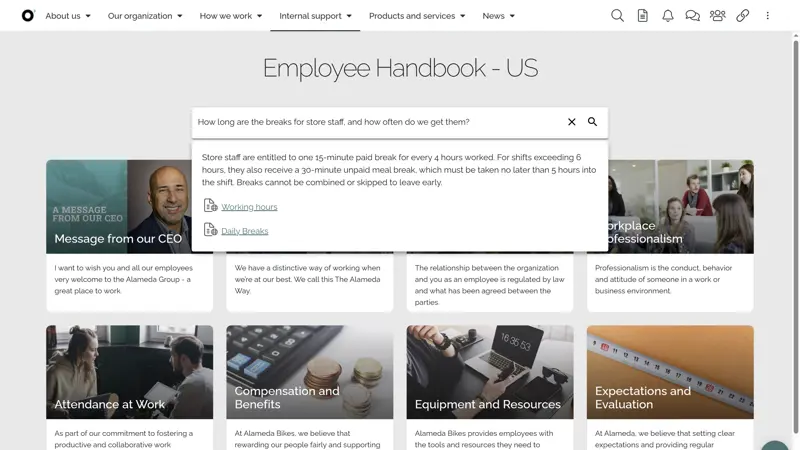
Across the Intranet, AI is moving from a helpful add-on to a foundational layer of the modern intranet. Employees now expect intelligent search that understands intent and delivers accurate, trustworthy answers. Editors want tools that improve content quality and reduce repetitive work. And organizations increasingly rely on automation to strengthen governance, reduce risk, and make informed decisions.
This shift also highlights a key prerequisite: AI can only perform well when content is properly governed. So, organizations will need strong lifecycle management and clear ownership to ensure AI-assisted search and agents return reliable results.
In 2026, successful intranets will treat AI not as an add-on but as a built-in capability — elevating quality, findability, and continuous improvement across the entire platform.
Intranet Feature Examples: AI-Powered Capabilities
These capabilities will become essential going forward:
✔ Automated governance checks that suggest metadata, assess tone and content quality, flag outdated information, and provide proactive improvement recommendations.
✔ Semantic search that interprets user intent and delivers more accurate, contextual, and personalized answers across trusted repositories.
✔ AI agents and assistants that guide employees through HR, IT, travel, or compliance scenarios using verified, organization-approved content.
✔ AI-driven analytics that identify usage patterns, surface insights, and notify intranet teams when content or features require action.
✔ AI-ready, well-governed content that ensures assistants, search engines, and automation return reliable, high-quality answers.
Intranet Transformation #5: The Seamless, Personalized, and Consumer-Grade Intranet
User experience is becoming one of the strongest differentiators of next-generation intranets. Both office and frontline workers expect the same simplicity, speed, and clarity they experience in modern consumer apps — personalized content, intuitive navigation, and the ability to act on tasks without switching between tools. Organizations, in turn, need a consistent, accessible, and on-brand experience across web, mobile, signage, email, Teams, and the wider Microsoft 365 ecosystem.
As intranets take on a larger role in daily work, UX is no longer a design preference — it is essential for adoption, productivity, and engagement. It is worth underlining that reaching distributed and frontline workers requires mobile-first experiences that make essential tasks and updates immediately accessible, regardless of device or work environment.
Intranet Feature Examples: User Experience
The following capabilities will be essential for the ongoing shift regarding intranet UX:
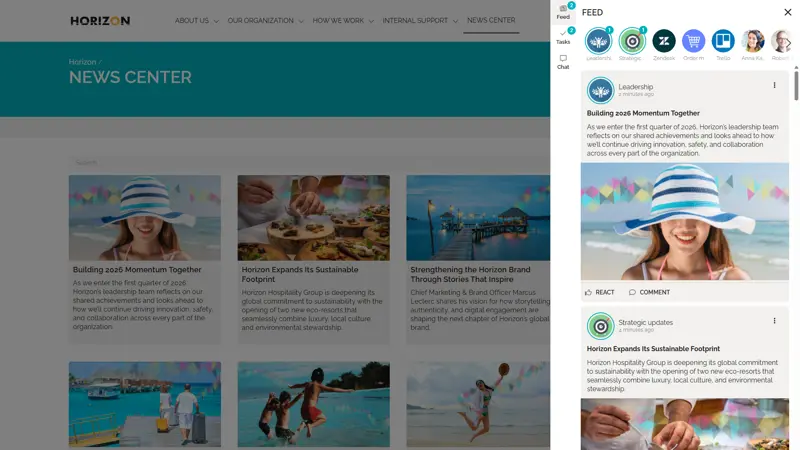
✔ Personalized user feed with social interaction, surfacing relevant news, announcements, polls, and tasks — alongside personal posts and peer-to-peer chat that strengthen connection and engagement.
✔ Integrated task execution, combining actionable task cards with a unified task overview that consolidates assignments from multiple systems into one clear, manageable list.
✔ Modern mobile app with a consumer-grade feel, helping employees — including frontline workers — stay informed and productive anywhere.
✔ Mobile-first experiences for frontline workers, ensuring essential tasks, updates, and communication are accessible even without desktop access.
✔ Consistent UX and theming across devices and channels, creating one cohesive, accessible, and recognizable intranet experience.
Intranet Transformation: How to Design the Next-Generation Intranet Solutions
The intranet of 2026 is no longer defined by static pages or isolated communication—it is shaped by intelligence, integration, and a clear focus on supporting employees in their day-to-day work. For intranet transformation in general, the direction is unmistakable: organizations need intranets that guide, simplify, and connect the employee experience through one unified, consistent, and accessible platform.
To move forward, understand the ongoing intranet transformation and consider how your intranet can:
✔ Shift from publishing to orchestrating communication and engagement across channels.
✔ Bring tasks, services, and knowledge together into one seamless work platform.
✔ Support the full employee journey with structured, personal, and meaningful experiences.
✔ Use of AI to strengthen governance, search, quality, and decision-making at scale.
✔ Deliver a consumer-grade UX across devices and channels—including mobile-first support for frontline workers.
The intranets that succeed in 2026 will be those designed with purpose to evolve and a sharp focus on creating everyday value.
If you want to dig deeper into intranet transformation shaping this evolution, you’re welcome to explore our free guide: Top Intranet Trends for 2026 and Beyond.
And if you’d like to see how these capabilities come to life in practice, you can also book a personalized Omnia demo—we’d be happy to walk you through what a next-generation intranet could look like for your organization.