
Community and Engagement in Intranet Platforms: What’s Working in 2026—and What to Plan for Next
Community and engagement capabilities are becoming a core part of modern intranet platforms as intranets evolve from broadcast channels into spaces for dialogue, feedback, and participation. In 2026, most intranet platforms include social and engagement features—but maturity, adoption, and impact vary widely across the market. This article explores how community and engagement capabilities are evolving in intranet platforms, where platforms are delivering real value, and how organizations should plan engagement approaches that build trust, participation, and long-term value.
Who this article is for: This article is for internal communications, HR, and intranet teams responsible for enabling employee engagement, feedback, and participation through the intranet.
What this article helps with: It helps teams understand how community and engagement capabilities are being delivered in intranet platforms, and how to design engagement approaches that encourage meaningful participation rather than superficial or unused social features.
Employee engagement is no longer driven solely by top-down communication. As digital workplaces become more distributed and hybrid work continues to shape how employees interact, organizations increasingly rely on intranets to support dialogue, shared understanding, and a sense of connection across teams and locations. In this context, community and engagement features have moved from optional enhancements to strategic intranet capabilities.
At the same time, employee expectations are influenced by consumer social platforms. Reactions, commenting, short-form video, and live interactions are now familiar behaviours, shaping how employees expect to engage at work. Following the sunset of Meta Workplace in 2024, many intranet vendors have expanded their native community and engagement functionality to fill the gap.
However, the Intranet & Employee Experience Platforms 2026 report shows that while social features are increasingly common, their depth, usability, and governance vary significantly—and not every approach is suitable for every organization.
This article examines how community and engagement capabilities are evolving in intranet platforms in 2026, based on independent product evaluations and market analysis from ClearBox Consulting’s Intranet & Employee Experience Platforms 2026 report. We highlight what is working well, where gaps remain, and how organizations can use these insights when planning or improving intranet communities as part of a sustainable employee experience strategy.
Main findings – how community and engagement are evolving
Across the intranet and employee experience platforms reviewed for the 2026 report, community and engagement features are now widely available—but their purpose, maturity, and impact vary significantly. Most platforms include some form of social interaction, yet only a subset have developed coherent engagement models that support meaningful participation rather than surface-level activity.
Overall, the findings show a clear shift away from broad, enterprise-wide social feeds toward more intentional, context-driven engagement.
Social interaction expectations continue to rise
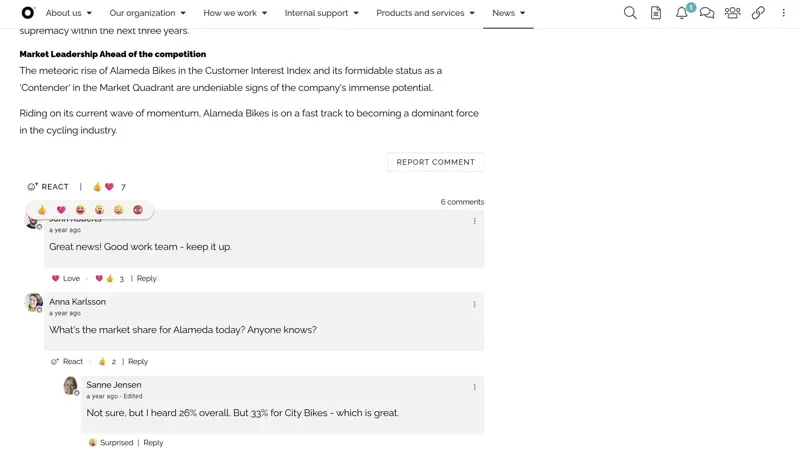
Employees increasingly expect intranet platforms to support lightweight interaction alongside formal communication. Simple “likes” are no longer sufficient; users want richer reaction options that allow them to express sentiment without always adding comments.
In response, more vendors have introduced multiple reaction types, improved commenting experiences, and richer media formats such as short-form video and livestreaming. These features are familiar to employees and can lower barriers to participation—particularly when used selectively and in relevant contexts.
Native community features are expanding—but approaches differ
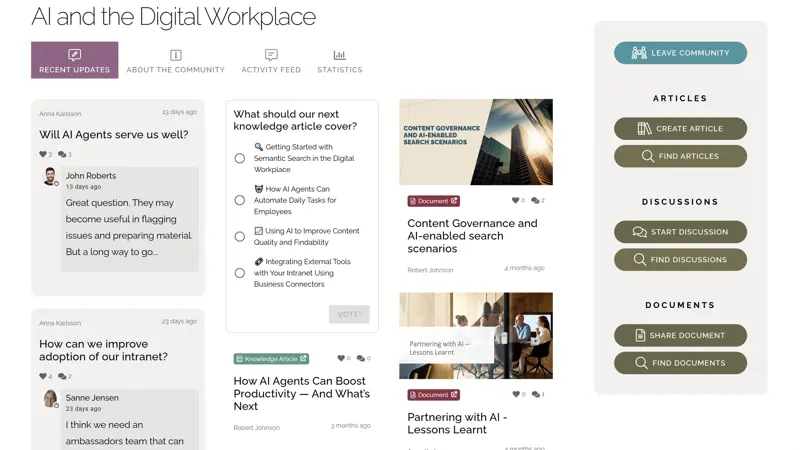
A growing number of intranet platforms now offer native community and discussion features rather than relying solely on third-party tools. This reflects both changing employee expectations and the ongoing impact of Meta Workplace’s withdrawal from the market.
However, vendor approaches differ. Some platforms provide fully integrated community spaces with discussion boards, activity feeds, and moderation tools. Others choose to integrate with Microsoft applications such as Viva Engage or Forms, particularly among SharePoint-based intranet solutions. While both approaches can work, native community features often provide greater consistency, governance, and integration with intranet navigation and content.
Feedback and “temperature check” tools are improving
Most platforms now include some form of polling or survey capability, enabling HR teams and communicators to gather feedback and run quick “temperature checks.” In some cases, these tools are strong enough to replace dedicated survey platforms; in others, they are intentionally lightweight and best suited to quick input rather than deep analysis.
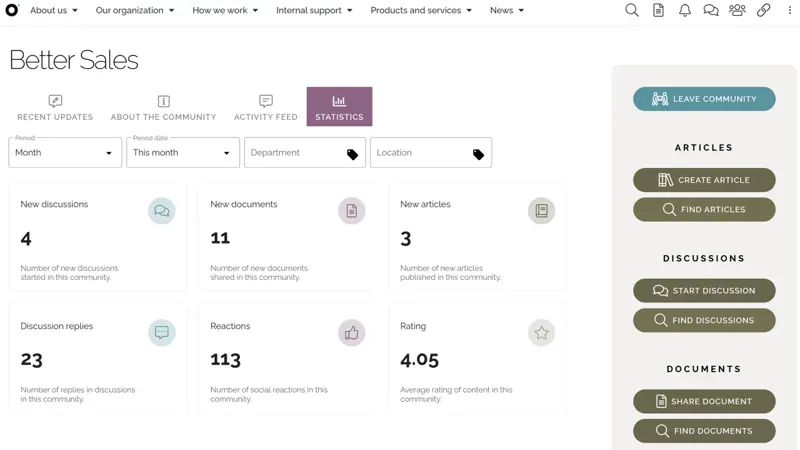
A key differentiator is how feedback data is surfaced and acted upon. Platforms that integrate results into dashboards or analytics views provide clearer value than those that treat surveys as isolated activities.
Recognition and lifecycle moments show uneven maturity
Recognition features—such as awards, celebrations, or employee milestones—are increasingly common, but depth varies widely. Some platforms offer structured tools that support consistent recognition programmes, while others rely on templates or generic content spaces that require manual coordination.
Similarly, while onboarding communities or lifecycle-focused spaces are common, few platforms support progression-based experiences with tasks, workflows, or automated guidance. This limits the long-term impact of community features on engagement and development.
Moderation and governance are gaining importance
As engagement features expand, moderation and governance have become more visible concerns. Platforms vary significantly in the tools they offer to manage inappropriate content, guide participation, and support community owners.
Organisations without clear moderation models risk either over-policing engagement or allowing spaces to become noisy and underused. Platforms that support role-based moderation, clear controls, and transparency around participation are better positioned to sustain engagement at scale.
Where community and engagement capabilities are heading
Community and engagement capabilities are evolving toward more intentional, purpose-driven use. Rather than attempting to recreate enterprise-wide social networks, intranet platforms are increasingly focused on lightweight, contextual engagement that supports specific business and employee needs.
From broad social feeds to contextual participation
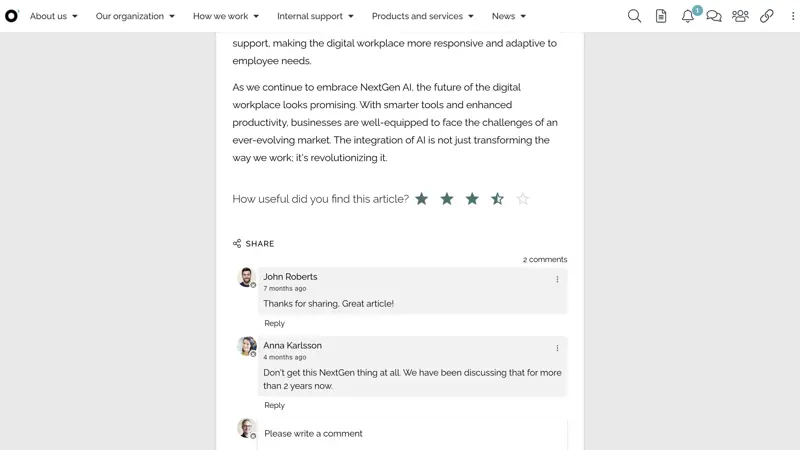
Large, all-employee social feeds are gradually giving way to more focused engagement models. Interaction is increasingly embedded directly into relevant contexts—such as news articles, knowledge pages, service areas, or project spaces—rather than separated into standalone social destinations.
This approach supports engagement where it adds value and reduces the risk of social features becoming noisy or disconnected from everyday work.
Communities of practice gain prominence
Communities are increasingly positioned as spaces for knowledge sharing, collaboration, and learning rather than general conversation. Communities of practice—centred on roles, disciplines, or shared challenges—are becoming more common and more structured.
Platforms that support clear community purpose, ownership, and lifecycle management are better suited to sustaining these spaces over time and aligning engagement with productivity.
Smarter feedback loops replace one-off surveys
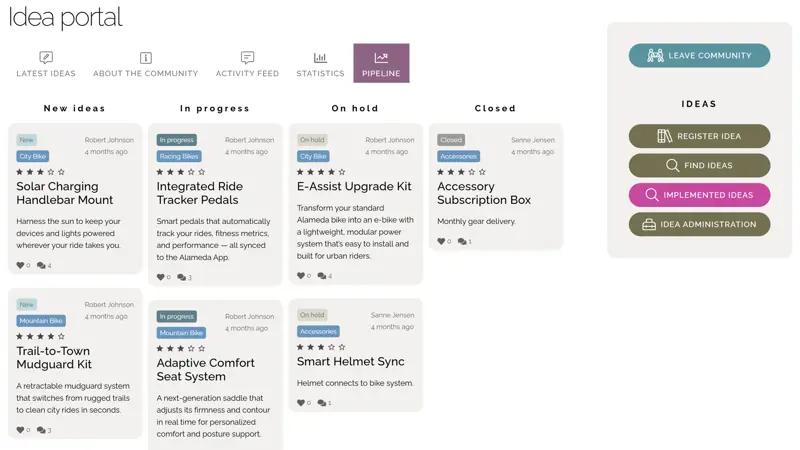
Feedback capabilities are evolving from isolated polls or surveys into more continuous feedback mechanisms. Rather than relying solely on annual engagement surveys, organizations are increasingly using intranets to gather timely input, test ideas, and respond to emerging issues.
Future development is likely to focus on:
✔ Easier feedback collection embedded in content and services.
✔ Better visualisation of trends and sentiment over time.
✔ Clearer links between feedback and follow-up actions.
Recognition becomes more structured and intentional
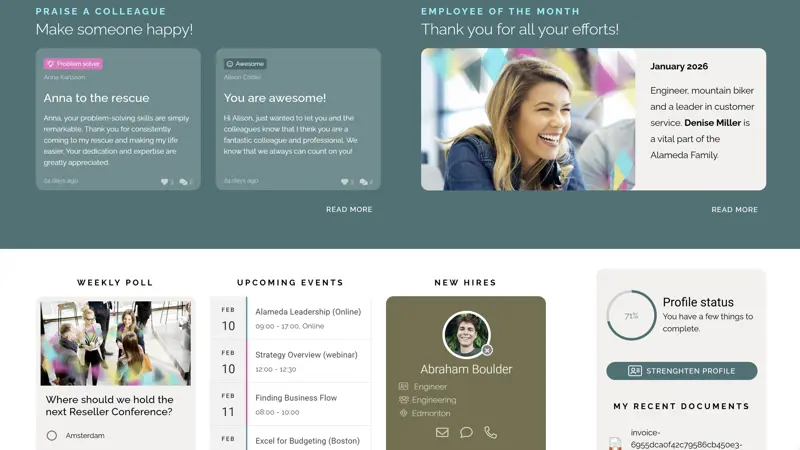
Recognition is moving beyond informal shout-outs toward more consistent, organisation-wide practices. While not all platforms offer dedicated recognition tools, there is growing emphasis on supporting repeatable and visible recognition that reinforces organisational values. We expect recognition to become more tightly integrated with broader engagement and communication strategies rather than being treated as isolated content.
AI supports insight and moderation—not conversation
AI is beginning to play a supporting role in community and engagement capabilities, but not as a replacement for human interaction. The most promising uses focus on moderation support, sentiment analysis, and surfacing engagement insights rather than generating conversation.
Used appropriately, AI can help community owners understand participation patterns, identify risks early, and improve the quality of engagement—without undermining trust or authenticity.
How organisations should use this information when planning community and engagement
Effective community and engagement on the intranet require clear intent, appropriate tooling, and sustained ownership. When planning a new intranet—or evolving engagement within an existing one—organisations should use the following checklist to guide decisions and priorities.
Practical checklist:
✔ Start with a clear purpose for engagement: Define what engagement should achieve and where dialogue adds real value.
✔ Choose the right level of social functionality: Use lightweight reactions and comments where appropriate; introduce communities only where ongoing interaction is needed.
✔ Design communities around ownership and intent: Assign clear owners, define participation expectations, and manage community lifecycles.
✔ Embed feedback into everyday experiences: Use polls and surveys contextually and share outcomes to build trust.
✔ Treat recognition as a repeatable practice: Support consistent recognition aligned with organisational values.
✔ Balance openness with governance: Establish moderation models, role-based controls, and analytics to support sustainable engagement.
Conclusion: Engagement is designed—not enabled by features
Community and engagement capabilities can significantly strengthen the value of an intranet, but they do not succeed on features alone. The 2026 market findings show that while social and engagement tools are now common across intranet platforms, meaningful engagement depends far more on intent, clarity, and execution than on feature breadth.
For practitioners, the key takeaway is clear: successful engagement is designed, not added. When community features are aligned with real use cases and supported by clear ownership, moderation, and feedback loops, they can build trust, surface insight, and strengthen connection across the organisation. When deployed without purpose or governance, they risk low participation or disengagement.
Learn more: To understand how community and engagement connect other intranet capabilities, explore the broader trend overview in this blog post - or dive into scenario articles on communications management, mobile and frontline experiences, platform management and governance.
Explore the full 2026 intranet landscape
This article is part of a series analysing the key scenarios from the independent Intranet & Employee Experience Platforms 2026 report by ClearBox Consulting.
👉 Learn more about intranet trends, capabilities, and platform comparisons: Download the full report to benchmark intranet platforms across all scenarios.