
Mobile and Frontline Support in Intranet Platforms: What Works in 2026—and What to Plan for Next

Mobile and frontline support has become a critical success factor for modern intranet platforms. As more employees work away from desks, the intranet must deliver reliable and relevant experiences on mobile devices. This article explores how mobile and frontline capabilities are evolving in intranet platforms in 2026 and how organizations should plan mobile intranet experiences that drive adoption, engagement, and operational value.

Who this article is for: This article is for intranet owners, frontline communications leads, and digital workplace teams responsible for delivering effective intranet experiences on mobile devices and for frontline employees.
What this article helps with:The text helps organizations understand what makes mobile and frontline intranet experiences successful in practice—and why desktop-first thinking continues to limit reach, adoption, and value.
For many organizations, mobile access is no longer an enhancement to the intranet—it is the primary way frontline and deskless employees experience it. Whether in healthcare, manufacturing, retail, logistics, or field-based roles, frontline employees often rely on mobile devices to stay informed, complete tasks, and access critical information. In this context, intranet success increasingly depends on mobile performance, not desktop design.
At the same time, delivering a strong mobile intranet experience is not simply a matter of shrinking a desktop interface. Frontline users have distinct needs and constraints: short interaction windows, shared or personal devices, limited access to corporate identity systems, and a strong focus on tasks rather than browsing.
The Intranet & Employee Experience Platforms 2026 report shows that while most intranet vendors now offer mobile experiences, suitability for frontline roles varies widely—particularly around onboarding, usability, notifications, offline access, and task support.
This article examines how mobile and frontline support capabilities are being delivered in intranet platforms in 2026, based on independent product evaluations and market analysis from ClearBox Consulting’s Intranet & Employee Experience Platforms 2026 report. We highlight what is working well, where gaps remain, and how organizations should use these insights when planning or improving mobile intranet experiences.
Main findings – how mobile and frontline support are evolving
Across the intranet and employee experience platforms reviewed by ClearBox Consulting in the 2026 report, mobile access is now universally available—but frontline readiness is far from consistent. While nearly all vendors offer responsive web experiences and most provide native mobile apps, the effectiveness of these solutions varies significantly depending on how well they reflect frontline realities.
Native apps are becoming the norm—but quality varies
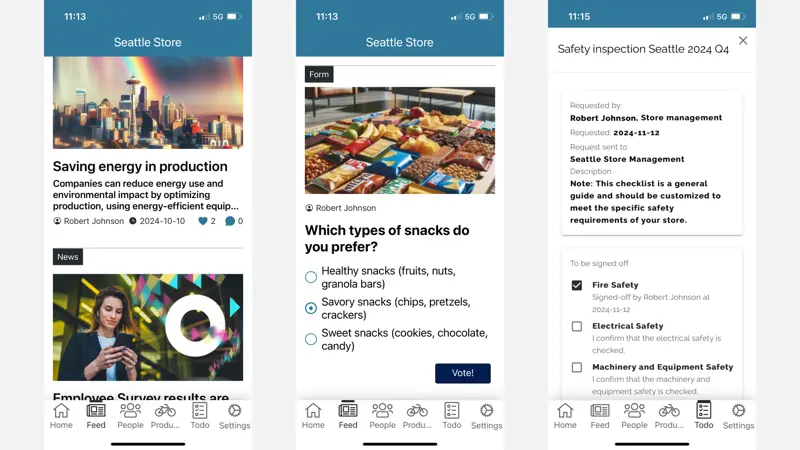
Most intranet platforms now offer native mobile apps rather than relying solely on responsive web experiences or embedded solutions such as Teams or Viva Connections. Native apps generally provide better performance, offline access, and notification handling, which are essential for frontline use.
However, not all native apps deliver an equally strong experience. In some cases, desktop features are simply compressed into a mobile interface, resulting in cluttered screens and reduced usability. Platforms that perform best are those that selectively prioritise mobile-appropriate features rather than aiming for full desktop parity.
Frontline onboarding and access remain major barriers
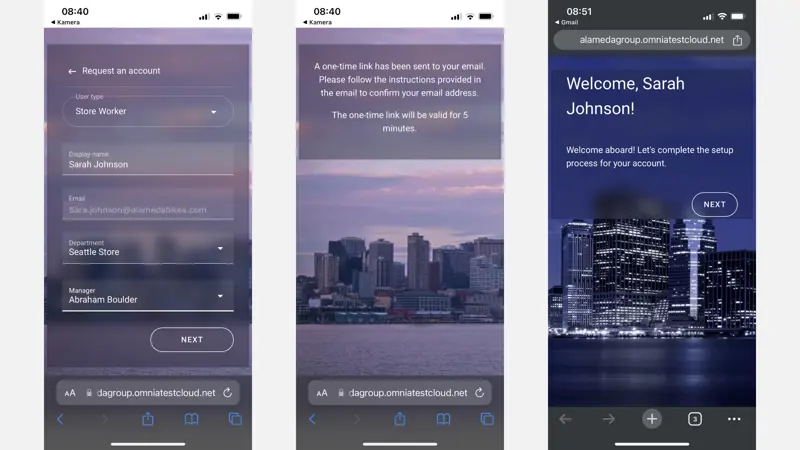
One of the most persistent challenges in mobile intranet adoption is onboarding frontline workers. Many platforms still rely heavily on centrally managed user accounts, corporate email addresses, or complex authentication processes that do not reflect how frontline employees access digital tools.
Platforms that support alternative onboarding methods—such as phone number or payroll-based access, simplified credential recovery, or manager-assisted enrolment—are better positioned to drive adoption. Where access is difficult or fragile, even strong mobile experiences struggle to gain traction.
Feature parity does not guarantee mobile usability
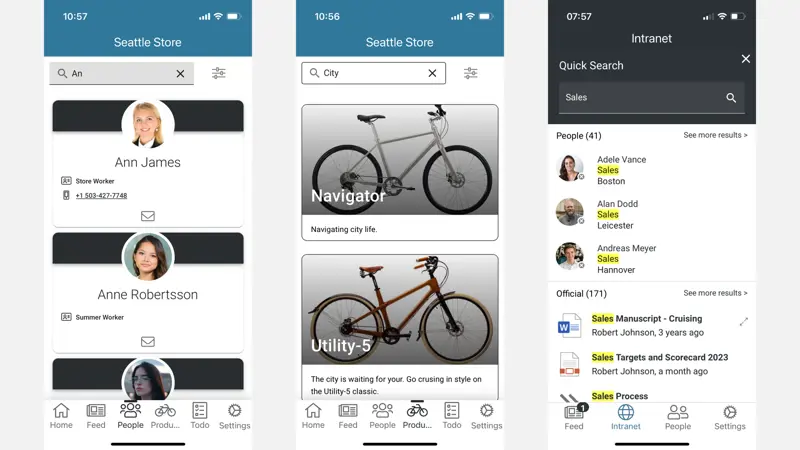
While most platforms aim to provide feature parity between desktop and mobile, this does not always translate into a good mobile experience. Search, navigation, and content discovery are often either overly simplified or excessively dense on small screens. In some products, key features are hidden, difficult to access, or behave inconsistently on mobile.
The strongest platforms design mobile experiences around common frontline tasks such as checking updates, completing simple actions, or finding critical information quickly.
Frontline-specific needs are still under-addressed
Despite progress, many intranet platforms still fall short in addressing frontline-specific requirements. Features such as shift-aware notifications, “do not disturb” periods, offline access, and integration with frontline services (such as payslips or schedules) are not yet consistently supported.
Where platforms do consider frontline contexts, the difference is clear. Mobile-first employee apps and frontline-focused solutions tend to deliver more intuitive experiences, while some broader intranet platforms are still adapting desktop-centric models to mobile use.
Mobile experience increasingly defines intranet success
For organisations with large frontline populations, the mobile experience is effectively the intranet. Weak mobile usability, fragile access, or irrelevant notifications can undermine adoption across the entire platform.
As a result, mobile and frontline support have become a key differentiator when evaluating intranet platforms—not a secondary consideration.
Where mobile and frontline intranet capabilities are heading
Mobile and frontline intranet capabilities are evolving away from desktop parity and toward experiences designed specifically for how frontline employees work. Rather than attempting to replicate the full intranet on a small screen, future development is increasingly focused on relevance, speed, and reliability.
Mobile-first design replaces desktop-down approaches
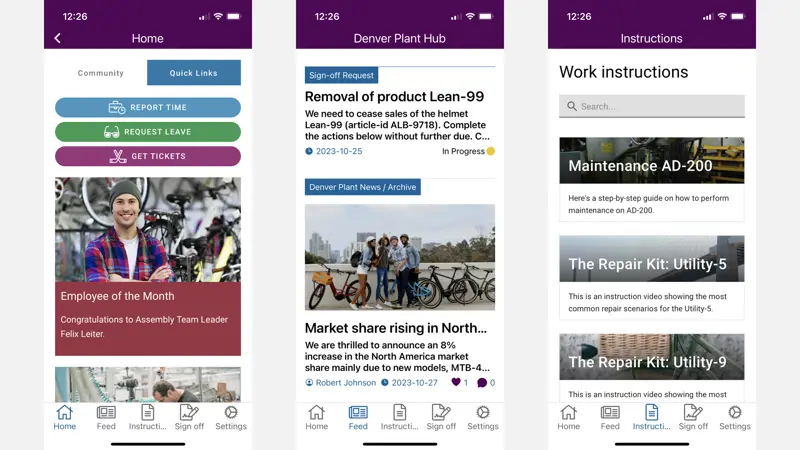
Leading platforms are moving toward genuinely mobile-first design. This means designing experiences around short sessions, frequent interruptions, and task-driven usage—rather than adapting desktop layouts.
As a result, mobile experiences are becoming more focused, with clearer prioritisation of content, simplified navigation, and reduced cognitive load.
Task-driven and shift-aware experiences gain importance
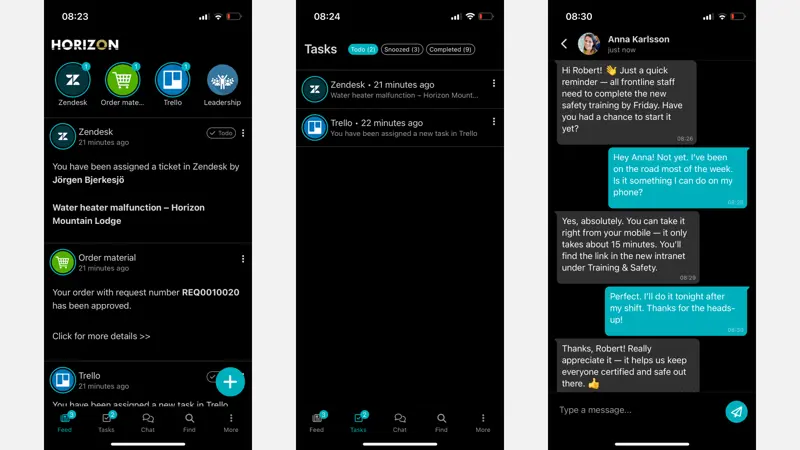
Mobile intranets are increasingly expected to support frontline work directly, not just communication. This is driving greater emphasis on task completion, shift-based relevance, and contextual delivery.
We expect to see more support for acknowledgements, forms, checklists, and operational updates, alongside better handling of shift patterns and working hours.
Notification relevance becomes critical
As mobile usage grows, notification overload has emerged as a major risk. Future platforms place more emphasis on relevance, urgency, and user control rather than volume.
Smarter prioritisation, clearer distinctions between critical and informational messages, and greater control over notification preferences are becoming essential for sustained adoption.
Selective integration with frontline services
Mobile intranet platforms are evolving to integrate more closely with frontline systems such as scheduling, payslips, training, and operational tools—but selectively. The focus remains on enabling quick access to high-value services and simple actions, while deferring complex transactions to source systems when needed.
AI plays a supportive role
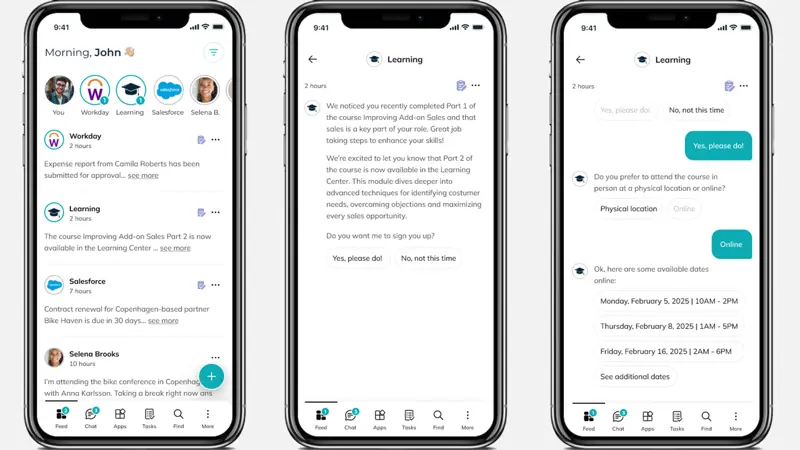
AI is beginning to influence mobile experiences through smarter search, summaries, and content delivery, but it is unlikely to redefine frontline intranets in the near term. As with other intranet scenarios, the most successful AI uses on mobile are supportive, purposeful, and governed.
How organisations should use this information when planning mobile and frontline intranet experiences
Successful mobile and frontline intranet experiences require deliberate planning and realistic expectations. Practical checklist:
✔ Start with frontline use cases, not desktop assumptions: Identify common frontline tasks and information needs; prioritise short, task-oriented interactions.
✔ Make access and onboarding frictionless: Support alternative identifiers, simplify authentication, and enable manager-assisted onboarding.
✔ Design for focus and speed: Prioritise essential mobile features; avoid clutter and unnecessary complexity.
✔ Govern notifications carefully: Respect shift patterns, distinguish critical messages, and give users control over preferences.
✔ Integrate frontline services selectively: Enable simple actions in the intranet; hand off complex tasks to source systems.
✔ Measure success differently: Track mobile adoption, task completion, and service usage—not just page views.
Conclusion: Mobile experience defines intranet reach
Mobile and frontline support is no longer a secondary consideration—it is central to intranet success. As more employees rely on mobile access as their primary connection to the digital workplace, the quality of the mobile experience directly determines intranet reach, adoption, trust, and long-term value.
The 2026 market findings show that while most intranet platforms now offer mobile solutions, only those designed around frontline realities consistently deliver impact. For practitioners, the key takeaway is that mobile success depends less on feature breadth and more on usability, access, relevance, and governance. Desktop-first designs and superficial mobile adaptations continue to limit reach, particularly among frontline and deskless employees.
To understand how mobile and frontline capabilities connect other intranet scenarios and capabilities, check our overview blog on how intranet capabilities fit together or explore the articles on Digital Workplace Integrations and Services, AI in Intranet Platforms, Communications Management and Platform Management and Governance in Intranets.
Explore the full 2026 intranet landscape
This article is part of a series analysing the key scenarios from the independent Intranet & Employee Experience Platforms 2026 report by ClearBox Consulting.
👉 To learn more about intranet capabilities, trends, and design examples, download the full Intranet & Employee Experience Platforms 2026 report to benchmark intranet platforms across all scenarios.