
Digital Workplace Integrations and Services in Intranet Platforms: What’s Working in 2026—and What’s Coming Next
Digital workplace integrations and services are becoming a defining capability of modern intranet platforms. Rather than acting solely as content hubs, intranets are increasingly expected to help employees access services, complete tasks, and navigate complex digital workplaces. This article explores how integration and service capabilities are evolving in intranet platforms in 2026, where maturity varies across the market, and how organizations should plan realistic, governed approaches to using the intranet as an effective digital workplace front door.

Who this article is for: This article is for digital workplace architects, IT leaders, and intranet owners responsible for integrating the intranet with business systems and employee services.
What this article helps with: It clarifies how digital workplace integration and service capabilities are evolving in intranet platforms, and how intranets can move beyond link aggregation to become a practical, governed front door to everyday work.
As digital workplaces become more fragmented, employees spend increasing amounts of time switching between systems to find information and complete tasks. In response, many organizations are once again positioning the intranet as a way to simplify this experience—acting as a central entry point that connects people to the tools and processes they need in daily workflows.
In 2026, this “digital workplace front door” concept is gaining renewed traction, driven by stronger integrations, service-oriented design, and emerging AI support.
Unlike earlier cycles where the front-door vision was largely aspirational, today’s intranet platforms are better equipped to support it in practice. Integrations with Microsoft 365, HR systems, IT service platforms, and line-of-business tools are more common, and some platforms now allow employees to complete simple tasks directly within the intranet experience.
This article examines how digital workplace integrations and service capabilities are being delivered in intranet platforms in 2026, based on independent product evaluations and market analysis from ClearBox Consulting’s Intranet & Employee Experience Platforms 2026 report. We highlight what is working, where gaps remain, and how organizations can use these insights when planning or improving intranet integrations as part of a sustainable digital workplace strategy.
Main findings – how digital workplace integrations and services are evolving
Across intranet and employee experience platforms reviewed for the 2026 report, integration and service capabilities have expanded noticeably—but maturity remains uneven. Most platforms now acknowledge that an intranet must do more than publish content.
However, the extent to which employees can act—not just view—within the intranet varies significantly. Rather than a single integration model, the market reflects a spectrum of approaches shaped by different assumptions about the intranet’s role in the digital workplace.
Integration breadth has increased faster than integration depth
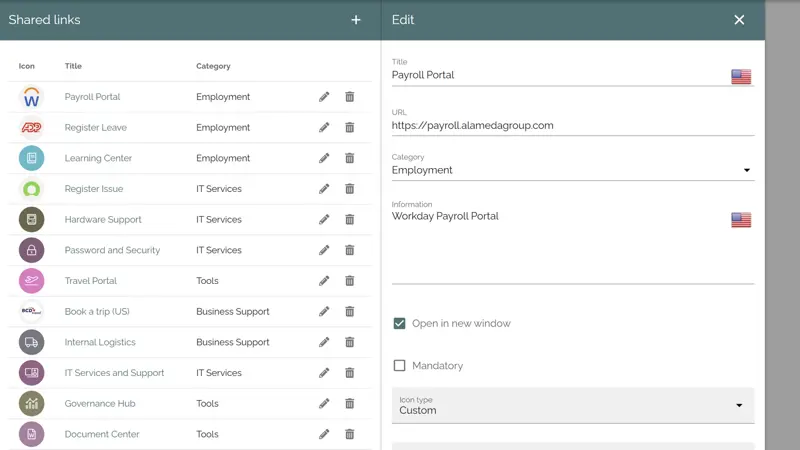
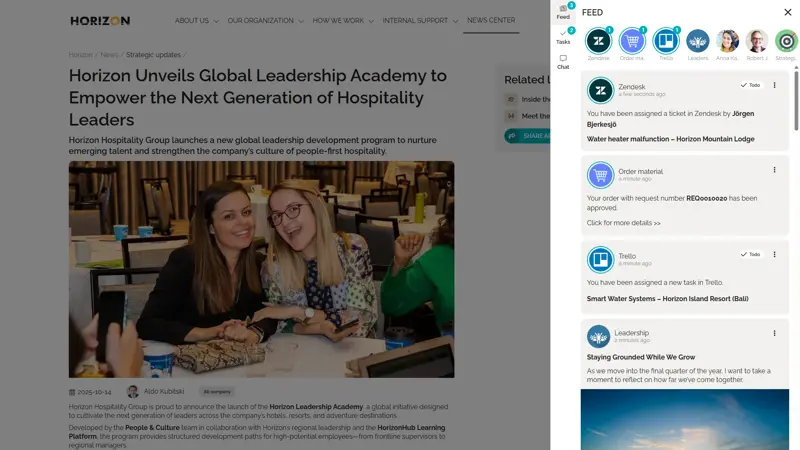
Most platforms now offer integrations with a broader set of enterprise systems than in previous years. Out-of-the-box connectors to Microsoft 365, HR systems, ITSM tools, and collaboration platforms are increasingly common. However, these integrations are often shallow. Many rely on:
✔ Configurable links with single sign-on.
✔ Embedded dashboards or pages.
✔ Read-only views of external systems.
While these approaches improve access and reduce friction, they typically require employees to leave the intranet to complete tasks. Only a smaller subset of platforms support two-way integrations that enable meaningful action directly within the intranet interface.
Task and service delivery are becoming a differentiator
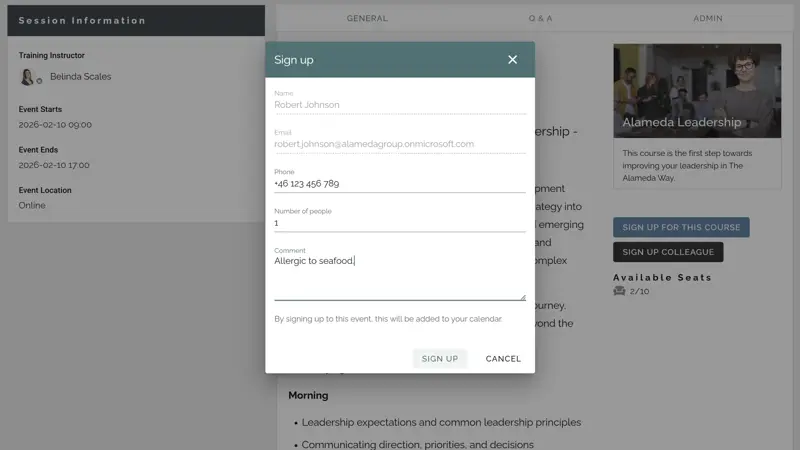
A clearer point of differentiation is emerging around task-oriented services. Some platforms now support intranet-native capabilities such as tasks, forms, approvals, or shift-based activities—particularly valuable for frontline and operational roles.
Rather than acting as systems of record, these intranets function as coordination layers: helping employees understand what needs to be done, take simple actions, and move efficiently to the right system when deeper interaction is required. When designed deliberately, this approach reduces context switching and improves usability—but it requires strong ownership and governance to scale.
Microsoft 365 integration is expected—but inconsistent
Integration with Microsoft 365 is now a baseline expectation, even for platforms that do not use SharePoint as their publishing foundation. Most intranet platforms integrate with Teams, Outlook, and SharePoint in some form, but the quality of these integrations varies significantly. Common challenges include:
✔ Limited ability to surface Microsoft content natively.
✔ Fragmented notification experiences.
✔ Gaps in federated search and task visibility.
Platforms that “intranetify” Microsoft content—rather than simply linking to it—tend to deliver a more coherent employee experience and better support findability and governance.
AI-enabled services are emerging, but are still limited
Despite significant attention on AI agents, most intranet platforms currently offer only early, domain-specific implementations. Where available, AI-enabled services typically focus on HR or IT self-service scenarios and depend entirely on existing workflows and integrations.
These capabilities do not create new processes; they automate what already exists. As a result, their value is closely tied to the maturity of underlying systems and governance models. While promising, AI-driven services are not yet a substitute for thoughtful service design or integration planning.
Governance and effort remain critical factors
Even platforms that perform well in this scenario typically require time, technical effort, and ongoing maintenance to deliver consistent value. Organizations that treat integrations as tactical add-ons often struggle to sustain them.
In contrast, organizations that define clear service priorities, ownership models, and success measures are better positioned to turn integrations into meaningful employee experiences rather than fragmented shortcuts.
Where digital workplace integration and service capabilities are heading
Digital workplace integration is not converging toward a single, all-encompassing solution. Instead, platforms are evolving toward more pragmatic, employee-focused models that prioritise value over technical ambition.
The intranet as a practical digital workplace front door
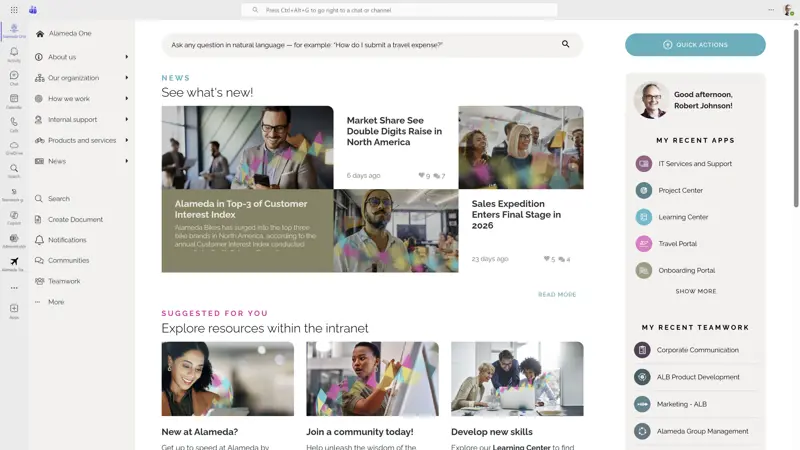
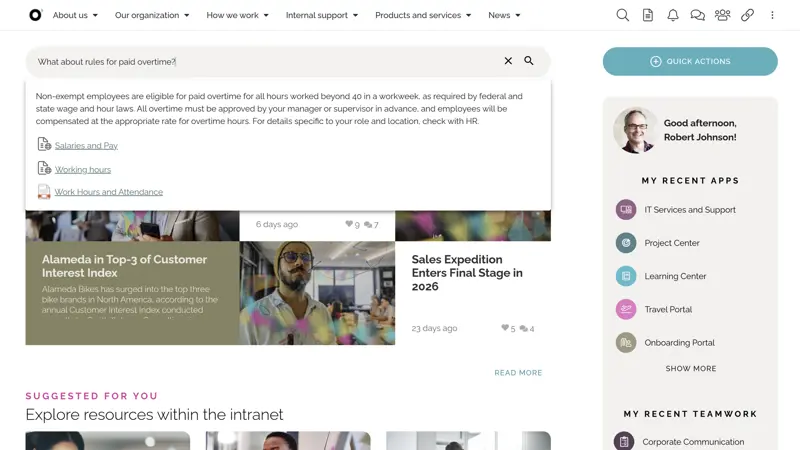
A renewed emphasis is emerging around the intranet as an intelligent entry point to the digital workplace. Rather than replacing specialist systems, the intranet acts as a guiding layer—helping employees discover services, understand required actions, and navigate complex toolsets more efficiently.
AI-enhanced search, contextual navigation, and service-oriented landing pages are all contributing to this shift.
From access to action—selectively
Future differentiation will come from depth rather than breadth. Successful platforms focus on enabling high-frequency, low-complexity actions directly in the intranet, while gracefully handing off more complex tasks to source systems.
This selective approach balances productivity gains with governance and maintenance realities.
Gradual expansion of agent-based services
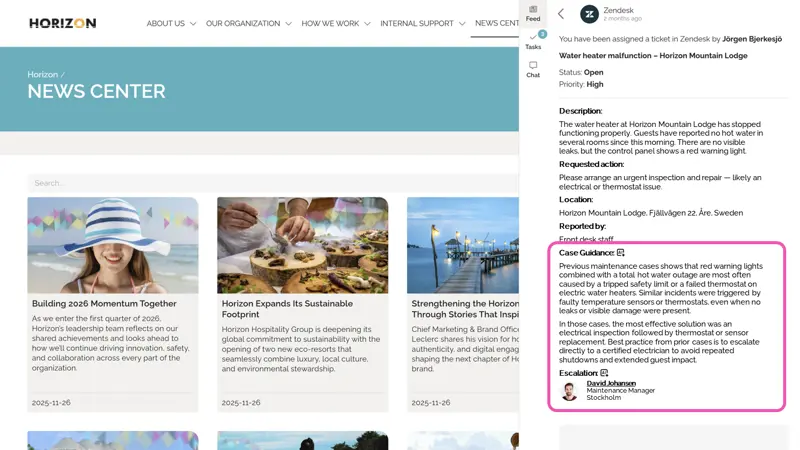
Digital workplace agents are expected to mature incrementally. In the near term, most platforms will continue to focus on domain-specific agents tied to standardised HR or IT services, with an emphasis on transparency, control, and auditability.
Governance as an enabler, not a blocker
As service capabilities expand, governance is becoming a prerequisite rather than an obstacle. Permissions, data scoping, lifecycle management, and audit trails are increasingly embedded into platform design, enabling safer and more scalable integration models.
Cost and operating models matter more than ever
Economic pressure is shaping integration strategies. Many organizations are favouring incremental improvements and modular extensions over large-scale platform replacements. Platforms that deliver measurable value without heavy custom development are gaining traction.
How organizations should use this information when planning digital workplace integrations and services
Digital workplace integrations deliver the greatest value when planned deliberately and aligned with real employee needs. Practical checklist:
✔ Start with tasks, not systems: Identify high-frequency, high-friction employee tasks before mapping integrations.
✔ Decide where actions should happen: Enable simple actions in the intranet; guide users to source systems for complex work.
✔ Plan integration depth deliberately: Use links for low-impact access; invest in deeper integrations for critical services.
✔ Treat AI as an enhancement, not a shortcut: Apply agents only to well-defined, governed processes.
✔ Build governance in from the start: Define service ownership, permissions, and lifecycle rules early.
✔ Adopt a phased, value-led approach: Start small, measure impact, and expand based on evidence.
Conclusion: Integration supports work—but does not replace systems
Digital workplace integrations and services are clearly reshaping intranet and employee experience platforms, but they do not change the fundamental role of the intranet. The most successful platforms use integrations to strengthen core scenarios such as information finding and search, employee services, communications delivery, and task completion—rather than attempting to replace underlying business systems.
For practitioners, the key takeaway from the 2026 market findings is that integration must be evaluated in context. Strong intranet outcomes still depend on clear service design, thoughtful governance, realistic scope, and disciplined platform management. Integrations can reduce friction and improve access to tools and services, but they do not eliminate the need for ownership, structure, or continuous improvement.
To understand how digital workplace integrations connect with other intranet capabilities and use cases, take part of our blog posts on Information Finding and Search, AI in Intranet Platforms, and Platform Management and Governance.
Explore the full 2026 intranet landscape
This article is part of a series analysing the key scenarios from the independent Intranet & Employee Experience Platforms 2026 report by ClearBox Consulting.
👉 Read the blog post summarizing the series and explaining hot the various use cases and capabilities fit together—or download the full Intranet & Employee Experience Platforms 2026 report to benchmark intranet platforms across all scenarios.