
Leadership Communication: How Strategic Storytelling Turns Strategy into Belief


Many strategies fail not because they’re wrong, but because they’re poorly communicated and quickly forgotten. This article shows how leadership communication improves when strategic storytelling is sustained over time. It explains how a modern intranet helps leaders turn strategy into a shared, ongoing narrative—making priorities clearer, progress visible, and employees more engaged in execution rather than just informed.

Most strategic initiatives fail not because the strategy is wrong, but because the organization never truly understands—or believes in—it. The narrative is unclear, the value feels abstract, and the momentum fades once the launch is over. This is a leadership communication challenge, not a strategy one.
Strategic storytelling isn’t about polished decks or presentation skills. It’s about sustaining meaning, relevance, and progress over time. When storytelling stops after the launch, even well-designed strategies struggle to translate into action.
In this article, we explore how a modern intranet can leadership communication through strategic storytelling by turning one-off initiatives into living narratives that employees understand, trust, and engage with.
Why Leadership Communication Often Breaks Down After Strategy Launch
Communicating strategy to employees is often treated as an event rather than an ongoing responsibility. A town hall is held. A strategy deck is shared. Expectations are set. Then attention moves on. Over time, common challenges appear:
✔ Role disconnect: Employees struggle to link strategy to daily work
✔ Missing context: Decisions and trade-offs occur without sufficient explanation
✔ Invisible progress: Progress and outcomes are unclear or hard to see
✔ Silent disengagement: Questions disappear as employees disengage over time
When leadership communication lacks continuity, belief weakens. Strategy doesn’t fail loudly—it fades quietly.
Strategic Storytelling is not a Moment—It’s a Discipline
Strong leadership communication depends on repetition, clarity, and relevance. Strategic storytelling is the practice of reinforcing why, what, and how as strategy evolves. Effective internal strategic storytelling helps employees:
✔ Priority clarity: Understand why priorities change over time
✔ Strategic alignment: See how decisions link to long-term goals
✔ Visible momentum: Recognize progress even when it’s incremental
✔ Shared ownership: Feel part of the journey, not just informed
This is where many organizations struggle. Not with ambition, but with follow-through.
The Intranet’s Role in Leadership Communication and Strategic Storytelling
The intranet is often overlooked in leadership communication—but it shouldn’t be. It’s one of the few platforms that can support intranet strategy communication at scale, over time, and across the organization. Used well, the intranet provides structure for strategic storytelling. It creates continuity, context, and visibility—helping leaders move from announcing strategy to sustaining it.
Here are five practical examples of how this works in everyday leadership communication.
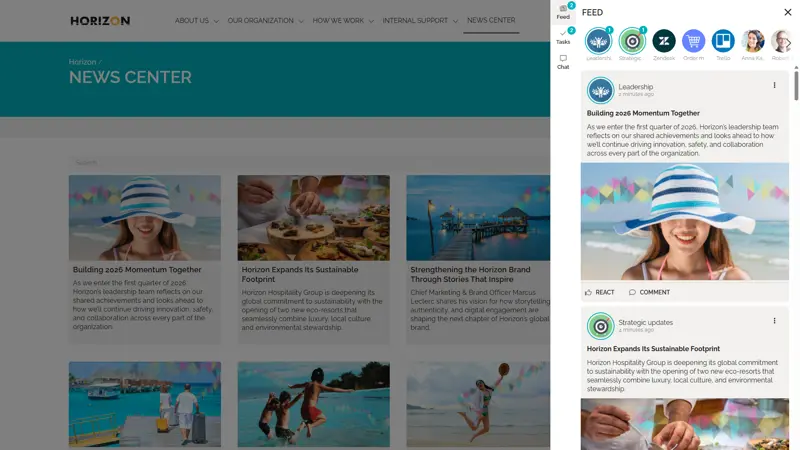
1. A dedicated strategy or initiative hub
Strategic storytelling needs a clear home. A dedicated strategy or initiative hub brings together the why, what, and how of an initiative in one place. It provides strategic context, goals, timelines, ownership, and updates—so employees always know where to find trusted information.
This supports leadership communication by reducing fragmentation and reinforcing clarity. Instead of relying on memory or outdated slides, employees can return to a single source of truth as the strategy evolves.

2. Ongoing leadership updates and decisions
Leadership storytelling becomes credible when it explains not only what is happening, but why.
Regular intranet updates from leaders help communicate progress, decisions, and trade-offs in a transparent way. These updates don’t need to be long or formal. Short, clear messages are often more effective. Make sure to publish articles across channels as intranet, digital signage, mobile app, and Newsletters—and perhaps even use Microsoft Teams or Slack as channels to drive reach.
By explaining how and why decisions are made, leaders strengthen trust and help employees understand the direction—even when plans change.
3. Visible progress, milestones, and outcomes
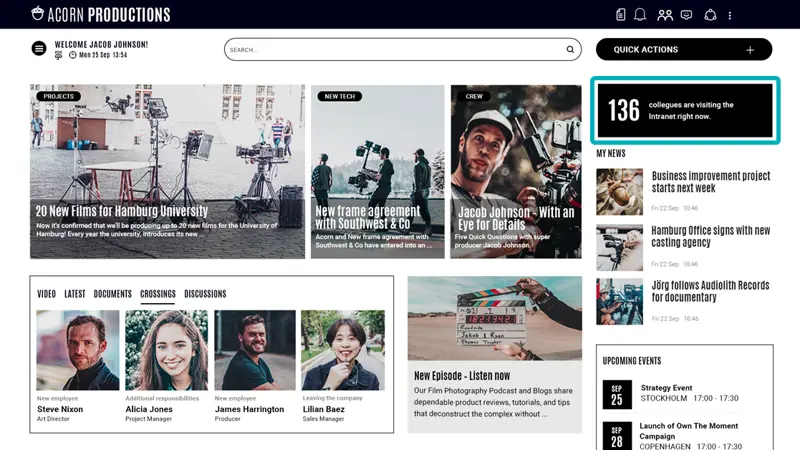
Belief grows when progress is visible. Making milestones, KPIs, and outcomes easy to follow turns abstract goals into something tangible.
Sharing what’s moving forward—and what’s proving challenging—supports honest leadership communication and keeps momentum alive. This can be different metrics and reports for different target groups, such as sales, production, logistics, etc., and reports that are updated frequently could even go onto the homepage.
To get this going, you could start by sharing metrics on intranet usage to signal 'community' and then move on to more business-critical reports for selected target groups. When employees can see progress over time, strategy feels real. When progress is hidden, confidence erodes.
4. Space for questions, feedback, and dialogue
Leadership communication should never be one-way. Enabling questions, comments, or structured Q&A on the intranet allows employees to engage with strategy, not just receive it. This creates room for clarification, learning, and feedback—without turning every concern into a meeting.
Just as importantly, it gives leaders insight into what resonates, what’s unclear, and where more explanation is needed. Strategic storytelling becomes a shared conversation, not a broadcast.
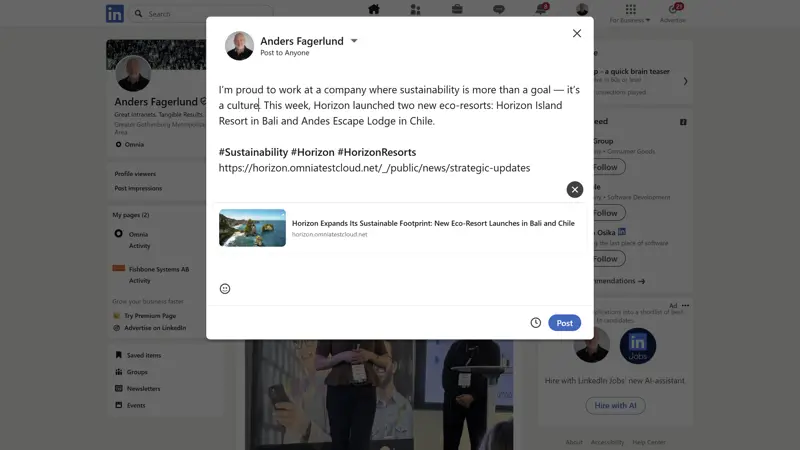
You can even set up the intranet in a way that allows employees to share selected stories externally, thereby strengthening advocacy for the organization.
5. Visual and video storytelling to reinforce the message
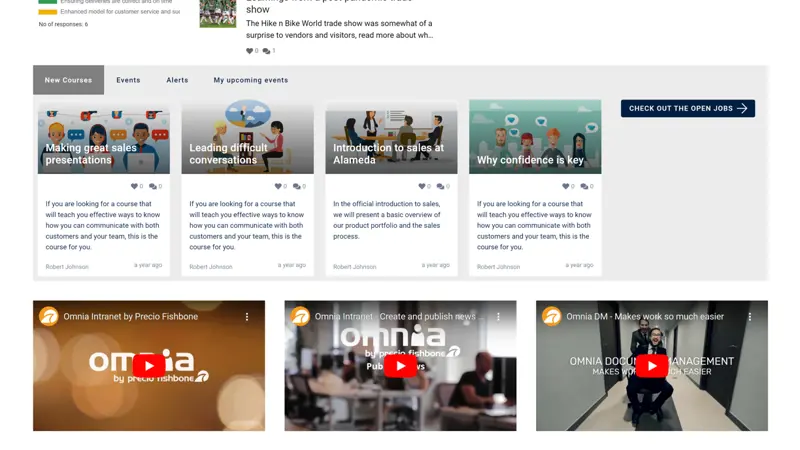
Some leadership messages are better seen than read. Short videos, visuals, and carefully chosen imagery help reinforce key messages and make strategy easier to understand and remember. Promoted videos on the intranet start page or visually strong news articles add tone, context, and human presence to leadership communication.
Used thoughtfully, visual storytelling supports clarity and connection—without adding noise.
From Isolated Initiatives to Shared Journeys
Without structure, strategic initiatives risk becoming isolated programs owned by a few teams. Strategic storytelling helps prevent this.
By using the intranet to connect context, updates, progress, and dialogue, leaders turn initiatives into shared journeys. Employees across roles and regions can follow the same story—even if their responsibilities differ.
This shared understanding strengthens alignment and makes strategy feel collective rather than imposed.
Leadership communication that sustains belief works when people:
✔ Strategic visibility: See the strategy clearly and consistently
✔ Personal relevance: Understand how the strategy affects them
✔ Sustained exposure: Experience the strategy repeatedly over time
Strategic storytelling provides the discipline to make this happen. The intranet provides the structure to sustain it. When leadership communication is continuous, transparent, and grounded in real progress, belief follows—and belief is what turns strategy into execution.
Ready to discuss improved leadership communication? Please reach out to set up a free 30-minute discussion with an intranet expert.
Learn more: This blog post is one of four in our series "Turning Strategy into Execution: How the Intranet Powers Modern Organizations". Take part in the other articles here:
✔ Architecting the Future Workforce: How the Intranet Enables Workforce Transformation
✔ AI in the Digital Workplace: How the Intranet Helps AI Deliver Real Value
✔ Leadership Development at Scale: How Intranets Build Stronger Leaders from Within