
AI Intranet Strategy Framework: The Four Pillars From Information Hub to Intelligent Front Door
We see modernizing an intranet with AI as more than adding a chatbot here or a search upgrade there. It requires a strategy: one that supports employees in becoming more effective in their daily work, and that deliberately covers governance, findability, integration, task completion, and more. Planning that strategy is best done against a clear framework. This article walks through our AI Intranet Strategy Framework: four pillars that lay out what organizations need to plan for as they build a modern intranet that moves from information hub to intelligent front door.
Key Takeaways
 The AI Intranet Strategy Framework supports organizations in modernizing their intranet – and it has four pillars: Front-Door, End-to-End Scenarios, Authoritative Content, and Governance & Trust.
- Front-Door is the primary digital workplace interface that an end-user interacts with in daily work. Organizations can work with several Front-Doors in parallel each being targeted or personalized for various user groups. Whether it's AI-native, hybrid, or third-party assistant, the other three pillars have to hold regardless of Front-Door.
- The modernized solution should support daily work in End-to-End Scenarios, from first question to completed task. This is where assistants, workflows, agents, and connectors should be combined to provide long-term operational value.
- Authoritative Content is key for the AI Intranet as a concept – and trustworthy knowledge bases are paramount for the End-to-End Scenarios. Since AI amplifies whatever content quality already exists, this underlines the necessity of continuous content governance.
- Every interaction with AI should use your organization’s security model and every action that AI takes must be logged for auditability. The solution must allow for switching between AI providers and should be measured on outcomes rather than usage. These governance characteristics are key for establishing trust among end-users.
This framework is grounded in Gartner's 2025 Magic Quadrant and Critical Capabilities for Intranet Packaged Solutions, which formally evaluates AI assistants, orchestration and automation, and platform extensibility as distinct capability areas, alongside our own experience helping enterprise organizations plan AI intranet strategies.
Like the features it supports, this framework is deliberately cross-functional. Front-Door decisions often sit with IT and Comms together; Authoritative Content ownership usually sits with Comms, HR, IT, and other business functions; Governance & Trust typically involves IT, legal, and security. Planning across these pillars together, rather than pillar by pillar in isolation, is what determines whether the strategy holds together in practice.
If you’re also interested in the specific AI features that should be part of the solution once the strategy is set, see our companion blog post Top 12 Features of an AI Intranet for Enterprise Organizations.
The AI Intranet Strategy Framework
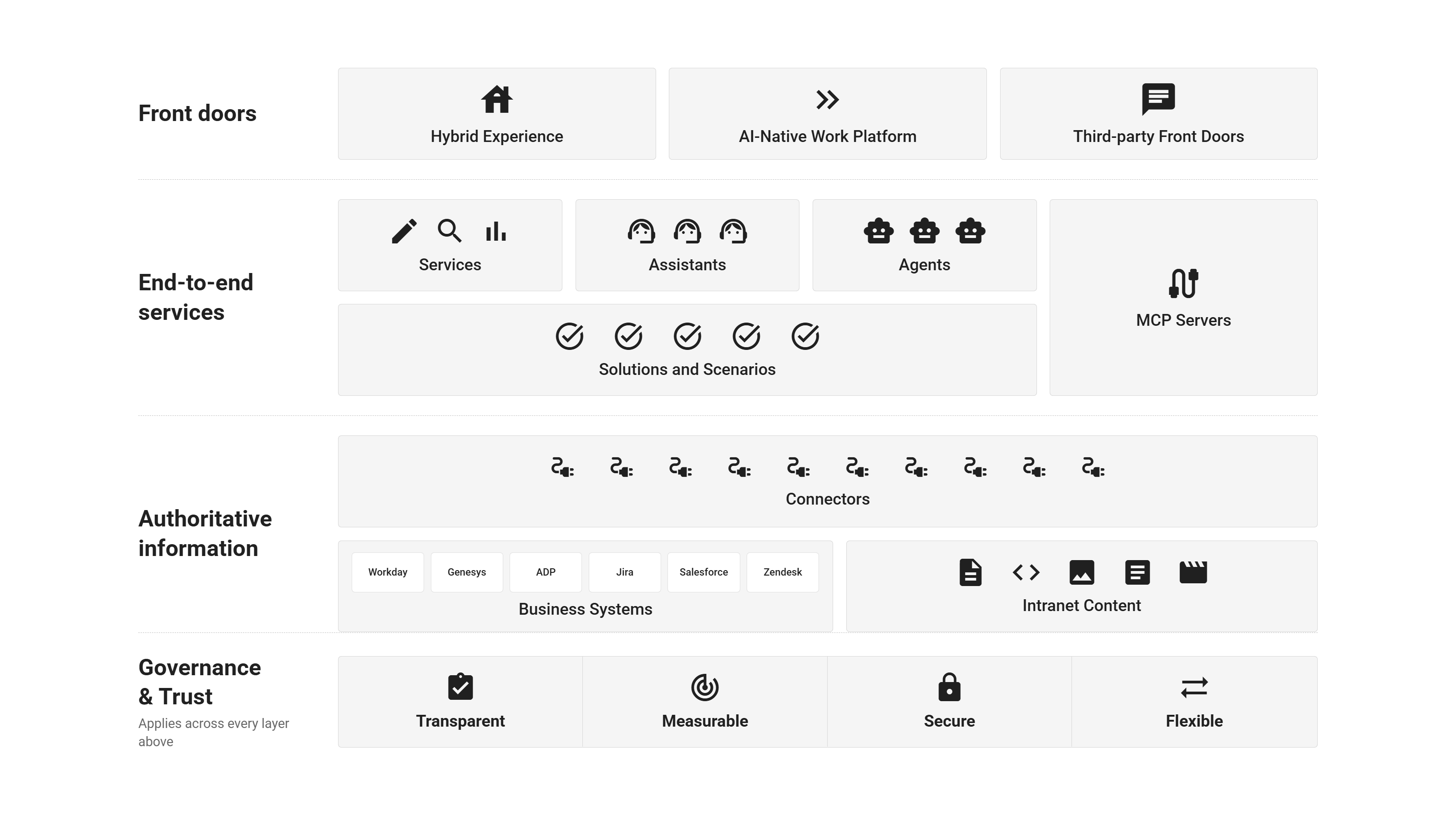
The framework is organized as three layers of capability, built on a fourth: a governance foundation that everything above it depends on. The image below shows a map of how the pieces relate.
Pillar 1: Front-Door
The front door is where employees start their working day. In many organizations this has been the intranet homepage, but that is no longer a given. Instead, we see different types of front doors being introduced, often in parallel.
Here are three examples of front doors, with the common factor that they are the layer employees actually interact with to be effective in daily work.
Hybrid Experience
Most organizations are on a journey rather than making an immediate switch. A hybrid front door keeps familiar navigation, news, and search in place while layering AI assistants and conversational capability on top, becoming more context-aware and proactive over time. This lets organizations introduce AI gradually, without discarding existing investment or employee habits.
AI-Native Intranet
For organizations ready to move faster, the intranet itself becomes AI-native: conversational interfaces, intelligent assistants, and task-oriented workflows are not an add-on, they are the primary way employees interact with it. Navigation still exists, but it becomes secondary to expressing intent and getting an outcome.
Information that employees need in daily work but don’t go search for – such as news, polls, announcements, and KPIs – still needs to be pushed to the end-user.
Headless and Third-Party Front Doors
Increasingly, the employee's starting point won't be the intranet at all — it might be an enterprise AI assistant, a digital workplace hub, or a custom conversational experience. This is where a headless architecture matters: it separates the experience layer from the content, governance, and business-process layer underneath it.
If your organization is using Copilot or Claude, this might be your tool for finding a work instruction or an invoicing address even though the content is hosted on the intranet.
How to Choose Front-Door?
Whichever interface the employee starts in, the platform behind it still needs to provide trusted knowledge, structured content, and enterprise context. Many organizations run this governed layer on top of SharePoint, using it as the content system of record while the intranet handles the orchestration and governance around it.
Organizations should not have to choose one model permanently. The same underlying content, governance, and intelligence can support an AI-native experience, a hybrid one, and third-party front doors at the same time, evolving as employee expectations change.
For a deeper look at this shift, see these blogs:
The Next Generation Intranet Isn't an Intranet – It's an AI-Ready Work Platform.
The Front Door Intranet: Turning the Intranet into a Platform Where Work Happens.
The Front Door Intranet in Practice: Guided Journeys, AI Agents, and How to Get Started.
Pillar 2: End-to-End Scenarios
Receiving a relevant answer to a question is not the same as completing a task, and this is the pillar where that distinction gets resolved. We've seen many organizations that invested in AI assistants discover that faster answers didn't translate into measurable productivity. Employees still had to go somewhere else to act on what they learned from the assistant. End-to-End Scenarios are built to close that gap.
From Answers to Outcomes
Whether an employee is onboarding, resolving an HR issue, or preparing for a customer meeting, the experience should feel seamless from intent to outcome. That requires four components working together: Assistants that understand what's being asked, Workflows that sequence multi-step processes, Agents that carry out work autonomously in the background, and Connectors that reach into the business systems where the work actually happens.
End-to-End scenarios support the process from the first question to completed task. From what to do if my mobile has been stolen – to the phone is blocked by IT and a new mobile has been delivered to the employee.
Built-In and Custom Scenarios
Time-to-value matters. Organizations shouldn't need months of design work before seeing results, which is why ready-made scenarios for common employee needs matter alongside the ability to build custom ones from reusable components: templates, prompts, connectors, and workflows.
Neither replaces the other; ready-made scenarios accelerate adoption, and the ability to build tailored ones is what makes the platform fit an organization's actual processes rather than a generic template.
Connectors, APIs, and MCP
Connectors are what make End-to-End Scenarios possible in practice, and most of them work through a mechanism IT teams have relied on for years: APIs. A defined way for one system to request information or trigger an action in another.
An HR system exposes an API for checking a leave balance; a ticketing system exposes one for creating a support ticket. Connectors use these APIs so an assistant, workflow, or agent doesn't need custom code written to talk to each system individually.
When discussing APIs there is a newer standard built specifically for AI available: MCP (Model Context Protocol). A traditional API is designed for one application to call another in a fixed way. MCP is designed so an AI assistant or agent can discover and use many different systems' APIs in a consistent way, without a developer having to hand-wire each connection separately.
In practice, that means faster and more reliable integration between the AI layer and the business systems it needs to reach, and it's a meaningful part of why building out End-to-End Scenarios is getting easier over time, not harder.
Choosing Where to Start
Treating End-to-End Scenarios as an all-or-nothing rollout is one of the most common ways an AI intranet strategy stalls. Not every scenario needs building at once. The ones worth prioritizing tend to share three traits:
They're high in volume, meaning many employees hit this need regularly.
They're well-defined, meaning the steps and systems involved are already known.
They're measurable, meaning there's a clear way to tell whether the task was actually completed.
Getting these three right is what turns End-to-End Scenarios from a technical build into something that actually boosts productivity for the employees using it. Onboarding, IT requests, and leave management usually qualify on all three. Open-ended or judgment-heavy processes usually don't, at least not first.
This pillar also underpins most of Gartner's IPS use cases directly. Employee and workplace services, knowledge services, work management, and resource portals all depend on assistants, workflows, agents, and connectors working together. Employee engagement is the exception, it draws more heavily on Front-Door and Authoritative Content than on orchestration.
This is also the pillar where strategy turns into specific capability decisions. For the concrete feature-by-feature checklist that maps to this pillar, see our companion piece, Top 12 Features of an AI Intranet for Enterprise Organizations.
Pillar 3: Authoritative Content
AI is only as reliable as the content it can access, and no amount of model quality compensates for ungoverned content. This is the pillar most organizations underestimate, because the effects of poor governance were survivable when a human was reading search results and using judgment. They are not survivable when AI is generating a confident answer from whatever it can find.
The Foundation for Trusted AI
Every important piece of content needs a named owner, an enforced review cycle, and validation before it reaches an employee through AI. This is what turns a collection of documents into a governed knowledge base rather than a pile of files with a search bar on top. It isn't a new discipline invented for AI; it is content governance that was always good practice, and that AI now makes non-optional.
Quality Starts at Creation
Governance shouldn't only catch problems after content is published. AI-assisted authoring can help content owners create clearer, more complete, more consistent content from the start, improving quality at the source rather than compensating for poor quality after the fact.
AI-assisted authoring can also flag tonality issues, abbreviations, or overly complex wording before content is published.
Continuous Knowledge Health
Content quality is not a one-time achievement. As organizations grow, content naturally becomes outdated, duplicated, or inconsistent, and without active monitoring, that decline is invisible until an employee, or an AI assistant, surfaces it as a confident but wrong answer. Ongoing content health monitoring – naturally strengthened by AI checking web pages and documents – can help keep the foundation solid over time, not just at launch.
For a deeper look at how knowledge and content management capabilities vary across intranet platforms, see Knowledge and Content Management in Intranet Platforms: What Matters in 2026.
Pillar 4: Governance & Trust
Governance & Trust is not a fourth component sitting beside Front-Door, End-to-End Scenarios, and Authoritative Content. It is the foundation the other three are built on. As AI moves from answering questions to taking action on an employee's behalf, organizations need a straightforward answer to one question: can we trust it? That answer comes from transparency, accountability, and control, not from promises.
Transparent by Design
Every AI-powered interaction, whether it's an assistant answering a question or an agent completing a task, should be observable and auditable. Comprehensive logging across AI interactions and automated processes is what lets organizations investigate issues, support compliance, and understand system behavior, rather than treating AI as a black box.
Measuring Outcomes, Not Just Activity
Usage and adoption metrics answer whether AI is being used. They don't answer whether it delivered value. Measuring outcomes directly, whether an HR issue was actually resolved, whether an IT ticket was actually closed, is what turns AI governance from a technical exercise into a business discipline.
Freedom of Choice and Security by Default
Organizations shouldn't be locked into a single AI provider, and AI shouldn't operate outside the organization's existing security model. Access controls, permissions, and security policies need to apply to AI-powered experiences exactly as they apply everywhere else. AI should inherit an organization's security model, not bypass it.
Governance at scale means organizations can see which assistants are performing well, which scenarios are creating value, and which content sources are trusted, and can act on that visibility. This is what allows innovation and governance to work together instead of competing with each other.
One AI Intranet Strategy for Every Type of Employee
A framework built on these four pillars can serve every type of employee, but only if delivery adapts to how different people actually work.
For office and knowledge workers: role-aware, personalized experiences through a web browser or Microsoft Teams. The assistant knows your function and seniority. Workflows surface the right next step at the right moment. Notifications arrive in the tools you already use.
For frontline and field workers: people who don't sit at a desk, don't have a laptop, and often don't hold a full Microsoft 365 license need something different: mobile-first, task-focused, and fast. A maintenance engineer reporting a fault. A retail employee requesting a shift change. A care worker checking a leave balance between visits. These interactions need to work on a phone, in under a minute, without navigating a portal designed for someone else.
The consequence of getting this wrong is a two-tier digital workplace, where one group of employees is supported and another is not. A unified AI intranet strategy, one governed framework adapting to every role, is both a practical and a principled choice.
The Front Door Intranet: From Destination to Outcome
The traditional intranet was organized around what each department needed to communicate. The result was a structure that made sense from the inside and was often opaque from the outside.
An intelligent front door is organized around what employees are trying to accomplish. Consider an employee who loses a company phone while traveling. In a traditional intranet model, they need to navigate a security portal, read a policy, find the right form, file a ticket in a system they rarely use, and then separately check the hardware catalog for a replacement option, across three or four different systems.
Under the AI Intranet Strategy Framework, the same journey runs through Front-Door and End-to-End Scenarios together: the employee describes the situation once, an assistant handles the conversation, a workflow coordinates the steps, and a connector reaches into the ticketing and hardware systems behind the scenes. The destination hasn't changed. The outcome has.
Learn More about AI Intranet Strategy
Want to go deeper? Join our webinar, The AI-Ready Intranet: From Information Portal to Work Platform, for more context, examples, and a chance to ask questions.
Ready to see this in practice? Book a demo and talk through what an AI intranet strategy looks like for your environment.
→ Download the 2025 Gartner® Magic Quadrant™ for Intranet Packaged Solutions
→ Download ClearBox Consulting's Intranet & Employee Experience Platforms 2026 Report
→ Top 12 Features of an AI Intranet for Enterprise Organizations — the feature-by-feature checklist that complements this framework.
→ The Next Generation Intranet Isn't an Intranet – It's an AI-Ready Work Platform
→ The Front Door Intranet: Turning the Intranet into a Platform Where Work Happens
→ The Front Door Intranet in Practice: Guided Journeys, AI Agents, and How to Get Started
→ Knowledge and Content Management in Intranet Platforms: What Matters in 2026
---- ---- ----
About the Author
Anders Fagerlund is an Enterprise Intranet & Digital Workplace Specialist and Omnia Coach at Omnia Intranet, based in Gothenburg, Sweden. He works across content strategy, product positioning, and analyst engagement, helping organizations think through what it actually takes to modernize the digital workplace.
---- ---- ----
Published: August 2026
---- ---- ----
Frequently Asked Questions
What is the AI Intranet Strategy Framework?
The AI Intranet Strategy Framework is a four-pillar model for planning an AI intranet strategy:
· Front-Door: how employees start their working day, whether AI-native, hybrid, or through a third-party assistant.
· End-to-End Scenarios: assistants, workflows, agents, and connectors working together to complete tasks, not just answer questions.
· Authoritative Content: governed, validated knowledge that AI responses can reliably draw from.
· Governance & Trust: the foundation of transparency, outcome measurement, and security controls the other three are built on.
Organizations plan for all four together, since none of the first three hold up without the fourth.
What does AI-ready intranet mean?
An AI-ready intranet is one where the content, structure, and platform architecture can reliably support AI-generated responses and AI-initiated actions. In practice, this means governed content with named owners and enforced review cycles, clearly scoped knowledge stores that define what AI can and cannot access, and a platform capable of connecting AI responses to real workflows and back-end systems. An intranet that hosts AI on top of ungoverned content is not AI-ready, it is AI-exposed.
What is a front door intranet?
A front door intranet is an intelligent work platform organized around employee outcomes rather than departmental content ownership. Instead of requiring employees to navigate to the right hub, fill in the right form, and manage the right system, a front door intranet guides employees from intent to completed task through a conversational interface, structured workflows, and connections to the back-end systems involved, regardless of which department or system owns the underlying process.
Does this approach still work if an enterprise AI assistant, not the intranet, is the front door?
Yes. The Front-Door pillar explicitly accounts for this: the same End-to-End Scenarios, Authoritative Content, and Governance & Trust apply whether the front door is an intranet homepage, a hybrid experience, or a third-party AI assistant. The front door is a choice about where employees start; the other three pillars still have to hold up behind it.
How should we modernize our intranet with AI?
Start with content, not capability. Before deploying any AI assistant, audit what content has a named owner, a current review cycle, and is accurate enough to power an AI response, and treat everything outside that set as a liability.
Then choose two or three high-volume employee journeys with clear steps (onboarding, IT requests, leave management are common starting points) and build those end-to-end before expanding. Avoid the temptation to deploy a general-purpose assistant across all content at once: scoped assistants built on governed content outperform broad assistants built on mixed-quality content every time.
What is the difference between an intranet assistant and an intranet agent?
An intranet assistant is reactive: it responds when an employee asks a question or starts a task, guiding them through the steps needed to complete it. An intranet agent is proactive: it monitors conditions, detects when something requires action, and initiates or completes tasks autonomously within defined boundaries, without waiting for an employee to ask.
An assistant handles the conversation. An agent works in the background. Both are necessary in a mature AI intranet strategy; they serve different parts of the employee experience.
Why is our intranet AI giving inconsistent or wrong answers?
In almost every case, inconsistent or wrong AI answers on an intranet trace back to a content governance problem, not an AI quality problem. AI models surface answers from whatever content they can access, and if that content includes outdated policies, contradictory guidance from different departments, or documents that have never been reviewed, the AI will return confident answers drawn from unreliable sources.
The fix is not a better AI model. It is governed content: named owners, enforced review cycles, and explicitly scoped knowledge stores that define what the AI is and is not allowed to use.
How do we know if our intranet is ready for an AI strategy?
Ask four diagnostic questions:
· Do your most important pieces of content have a named owner and an active review cycle?
· Do you have a clear definition of which content is authoritative enough to power AI responses, separate from informal or unvalidated material?
· Can your platform connect an AI conversation to real actions in connected systems, not just surface a link?
· Do you have a way to measure whether employees completed the task they started, rather than just whether they visited a page?
If the answer to any of these is no, that is where your AI intranet strategy needs to start.
Which are the top platforms to evaluate for an AI Intranet?
Our recommendation is to study the reports 2025 Gartner Magic Quadrant for Intranet Packaged Solutions and Intranet and Employee Experience Platforms 2026 by Clearbox Consulting for independent reviews of leading intranet products. High-scoring products – besides Omnia – are typically Appspace, LumApps, Staffbase, Simpplr, Unily, Workvivo, Interact, and Firstup.
For a side-by-side comparison across these platforms, see Best Intranet Software 2026: Top Platforms Compared.
--- --- ---
SEO TITLE: AI Intranet Strategy Framework: The Four Pillars Guide
SEO DESCRIPTION: Plan your AI intranet Strategy with a clear framework: Front-Door, End-to-End Scenarios, Authoritative Content, and Governance & Trust. See how the four pillars fit together.